Showing posts with label Spring. Show all posts

Wednesday, May 27, 2015

Big Texas Weather: Same Old Climate, Same El Nino Events Cause Texas Floods and Texas Rains

There is nothing unusual about the rain or flooding that Texas and Oklahoma are experiencing. It is actually a feature of our same old climate, and happens especially often in El Nino years.  During these past years of drought (which are also a normal feature of our same old climate), we've all been pulling for an El Nino to show up with the lovely rain it always brings. 

We mourn the tragic loss of life... flash floods are the only weather I fear, and they kill more people each year than all other weather events combined. That is no comfort to the grieving families. Please learn how to be safe in heavy rain, and never cross a water-covered road. 

But we must also be grateful for the abundance of rain that fills ranch tanks and the lakes that provide our water supplies. These rains are even replenishing underground aquifers, storing water for the long haul. 

An enlightening statement,courtesy of Floodsafety.com,  gives us the facts about these floods: 
"Flooding from large storms has affected Texas throughout its history...and destructive floods occur somewhere in the State every year. Many of these floods are destructive because they often occur in areas where extreme flooding had not occurred for many years. These floods often are perceived as unexpected or even unprecedented because their peak water-surface elevations (stages) can greatly exceed those of past floods." 
More facts from the same source as of 2002: 
  • *Texas has had 256 major floods (41 catastrophic) from 1853 thru 2002. 
  • *From 1986 to 2000, Texas experienced 4,722 flash flood events.
  • *" Central Texas has been identified as the most flash-flood prone area in the United States by the National Weather Service." 
  • *"Texas holds 6 of 12 world record rainfall rates in 24 hours or less - source United States Geological Survey (USGS)." 
  • *"Texas leads the nation in flood-related deaths most every year -- averaging twice the next nearest state: California." 
So please, young AP writers, don't be fooled into thinking this rain and these floods are unusual or "historic", because... they are both, but only to the degree that Texas weather is, like so much else in Texas, always larger than life. In fact, if you read Cabeza de Vaca's account of his Travels through Texas in 1528, you might be surprised to find that the climate is much the same as it is today, with the same edible plants growing in the same locations and the same bitter cold coastal winters, even the same merciless mosquitoes. 


Tuesday, March 10, 2015

Starting My Tomato Seeds Indoors


It is that time of year again!  Once more I am using "Byron B's Weak Tea" method. I did this last year and nearly every seed sprouted and grew. Byron B is a member of the TomatoMania Yahoo Group, and I learned about this from reading the archives there.

Sunday, April 20, 2014

Raising Tomatoes, Part 4: Folklore: Planting Before Good Friday & Rain on Easter


This year, I set a goal of learning how to raise tomatoes successfully. I am part way there, as I raised about a hundred plants from seed. I was surprised at how few died off in the seedling stage: hardly any did. So when I got antsy, and planted after we saw the old mesquite trees leafed out (they are always the last to show up, when it is good and warm), naturally we had a frost before Good Friday (the other rule is don't plant before Good Friday because we often have frosts right up to Easter, no matter how late in April Easter falls).

I covered each of them with glass mason jars or 5 gallon buckets, but they still all froze to death. Fortunately, I still had about 25 left of those I "raised from scratch", and was able to buy some interesting varieties to fill them out. I would have planted today, but IT IS RAINING!!!!! Isn't God good? There is another bit of lore, that if it rains on Easter, it will rain for the next seven Sundays. The last time this happened, I tracked it, and it rained within 36 hours of Sunday on 6 out of the following seven weeks.


Our friend Herb came this week and blessed us by installing a drip system in my garden. This is made with drip tape, so has an outlet built in each 16 inches. He suggested I plant tomatoes 32 inches apart, and put something tall, like corn or okra, between them.  Herb did this out of simple Christian love, recognizing a need without prompting. And then he prayed over Paul while he was here.  If you have wondered, this is what Christianity in action looks like.  We have received so much during Paul's illness and recovery, there have been uncountable blessings from others who follow Jesus Christ.  God has surely given us goodness and mercy.

Back to tomatoes. I was upset for a couple of hours after I discovered the plants I worked so long to raise had died. But I felt better after I realized I can still test a fairly broad array of varieties to see which are best for me, here in the drought-intensified Texas heat. The tomato varieties I have ended up with are:
Homestead
Better Boy
Celebrity
Rutgers
Porter
Black from Tula
Black Cherry
Pink Tye Dye
Old German
Pineapple
Mountain Spring
Black Krim

There might be a couple of others but it is hard to read my writing on the little cups after they have been wet so long. I used waxed Dixie cups to pot them in and wrote on them with black sharpie. It was very clear originally but over time has faded. Next year I guess I will use popsicle sticks.

Some of these tomatoes are bush types, and others are what they call "indeterminate" which means they grow long and tall. I will let them sprawl, since there are too many to try to cage or support.  Plus, since I have the drips on them now, there is less chance of them going to sleep wet (wet leaves are bad for tomatoes - I killed all mine one year by watering them with the sprinkler. They got fungal diseases and turned up their toes.).

Wish me luck - tomorrow they go into the ground! :-)

Tuesday, March 11, 2014

Growing Tomatoes From Seed, Part Three: Getting Their Second Leaves - and Their First Fertilizer


This year, I set myself the task of learning how to grow tomatoes, from seed to harvest. I've never had any luck with them, but others succeed, so surely I can figure them out too.  If you want to follow along, here are the links to Part One and Part Two of our thrilling adventures in Tomato Land.

When I planted my sprouted tomato seeds, I put them into Dixie cups in new potting soil that supposedly had fertilizer in it, so I did not think I would need to fertilize the seedlings until they had grown a bunch of
leaves.

I had two groups under the lights: the first, large batch that I had put in baggies about Feb 15th to sprout, and three other varieties that I ordered late, and didn't get sprouted until about 10 days later.  As of today, those last three seem to have caught up with the first batch, and about as many are sprouting second leaves on all of them.

The first batch grew like champs for a while - most sprouted within a week. I planted the ones that had not sprouted along with their precocious neighbors and most of those finally stretched and woke up too. I moved
them into little cups and they bounced right up and looked strong.

But then it was like time stood still. They reached a point and just stopped. I thought it might be a water issue, since the air and weather are so very dry here, so I stepped up their watering schedule. They still didn't improve.


Many of them started turning yellowish. So I read my little guide from Park Seeds, which said to fertilize them, and I read my fertilizer label, which listed a dilution for seedlings, and fertilized them.

The next day they were not improved - but they were no worse - so I diluted a half tsp of ammonia in a gallon of water and gave them that. (Not the whole gallon, but they each had a drink.)

Still no change the following day. So yesterday I watered them with fertilizer water again, just drenched them. FINALLY, today they are looking greener and starting to move forward with their second leaves.

Now to keep watching them. If it ever stops freezing at night, I will move them back into the sunny, South-facing laundry room, where they can get daylight. But for now, we are still alternating between 80 degrees one day, 30 degrees that night and 50 the next day. Springtime in Texas! LOL!

 Tune in again in a couple of weeks for the next episode. :-)

UPDATE: The results were fantastic!  Here are photos of some of the harvest!

Sunday, February 23, 2014

Starting Tomato Plants From Seed, Step 2: Moving Sprouts From Paper into Pots


 This is Part 2. The first post (click here to read it) explains how to start the seed using weak tea, paper towels and baggies. This post shows how to pick them out and move the little seedlings into pots, where they will grow until time to set them out.  

  Now, just 3 days later, most have sprouted, some even have their first set of leaflets. Some have only just begun to open, or maybe even have not sprouted yet, but they have had a good soak, so I will plant them all now.


Use tweezers to gently pick them up by the seed casing (the cotyledon)  - never touch the root! Tug gently, straight and level, to remove from the paper without bending the plant.  If the root has already penetrated the paper and doesn't pull free easily, don't worry - instructions below on how to save it.


Lay the little plant, root end down, against clean wet potting soil in a paper cup, newspaper pot, peat pot or plastic six pack from other plants.


  Cover gently - but not deeply - with more damp potting soil. Just barely cover it. It is ok if you get a bit of earth on the cotyledon, it will grow out of it.

If the seed has not yet sprouted at all, put it with the point side down and just barely cover it with a sprinkle of dirt.


 If the root is caught in the paper, simply cut out a square of paper around the root, being careful not to touch or cut the root in the process.


Then just plant the piece of paper towel along with the little plant:  root down, covered with soil, cotyledon side up, barely covered at all. 


Place them all under lights to keep them warm and give them the light they need. I used T8 daylight bulbs in cheap 4 foot shop fixtures that hang from chains. Hang the lights about 2 inches above the plants.


And watch them grow!!!  Be sure to mist them daily, maybe twice daily if it looks like they need it. I used bottled water so that it won't have any chlorine in it, but you can also use tap water that you let sit overnight first.  If you don't have a spray bottle that gives a fine mist, you could also use an eyedropper. Even better, according to many, is to water from below by poking holes at the base of the cups, setting them on a tray and putting the water in the tray. If using newspaper or peat pots, you wouldn't even need to make holes. :-)


 I laid a tinfoil shade over the fixture to keep the light and warmth in, and to let the light reflect as much as possible onto the plants.


And there they are, right at a week  after they were first put into their papers: little heads popping up, some getting taller already, others still stretching to get the kinks out as they wake up from their long sleep.  

Have fun with your seedlings, and I will post again soon to show how they are coming. :-)

UPDATE March 11, 2014: The third post is up: click to read - and thank you! :-)


Friday, April 20, 2012

Roses & Pecan Trees are Blooming!


 These are from the only rosebush that survived the drought, but oh aren't they gorgeous! Paul commented that they "are almost florescent": a beautiful orangey coral color.

Just as glorious in their own way are the fresh, day-glo green, male pecan tree flowers. You can see the long strands of pollen-rich catkins hanging in clusters. The female flowers are too small to see, but they are just above the catkins - Pecan trees only make female blossoms if all conditions are right: enough water, enough sugars and starches....and to date no one has figured out a scientific way to consistently predict the crop. It is so unique each year that pecans are called "God's crop" by the botanists and growers who study these trees.


I am betting on a great crop from our trees this year, in part because it has been several years since we had a bountiful one, and we've had good rain (thank you, Father God, for answering our prayers and sending rain to tide Texas over despite all predictions to the contrary. The drought is not gone, but we are grateful things are much improved in most of the state).

One of our trees is a native pecan that has the sweetest nuts. I gathered 100 pounds (before shelling) from it alone our first year here. We are just finishing them up (shelled and froze them in vacuum packs), so it would be a great blessing to have a new crop to stock up again.

If you want to produce as much of your own food as possible, do consider nut trees. You can have them in cities, and even a small lot can have a pecan tree. They produce a huge amount of high-calorie, healthy food with minimal effort once they are established. Pecan trees will not grow everywhere, but here they just come up from forgotten nuts that get buried. So look around and see what grows well where you live, and add the best possible "Edible landscaping" to your yard! :-)

Sunday, April 8, 2012

Jesus Christ Is Risen! Alleluia!

May eternal joy be yours! Happy Easter with God's rich blessings to all!


Death Be Not Proud
Death, be not proud, though some have called thee
Mighty and dreadful, for thou art not so;
For those whom thou think'st thou dost overthrow,
Die not, poor Death, nor yet canst thou kill me.
From rest and sleep, which but thy pictures be,
Much pleasure; then from thee much more must flow,
And soonest our best men with thee do go,
Rest of their bones, and soul's delivery.
Thou art slave to fate, chance, kings, and desperate men,
And dost with poison, war, and sickness dwell;
And poppy or charms can make us sleep as well
And better than thy stroke; why swell'st thou then?
One short sleep past, we wake eternally,
And death shall be no more; Death, thou shalt die.

-- John Donne


Romans 5:9-11:
"By his blood we are now put right with God; how much more, then, will we be saved by him from God's anger!
"We were God's enemies, but he made us his friends through the death of his Son. Now that we are God's friends, how much more will we be saved by Christ's life!
"But that is not all; we rejoice because of what God has done through our Lord Jesus Christ, who has now made us God's friends
."


Art is "The Resurrection" by Peter Paul Rubens, 1611 AD (scroll down at the link to find the commentary on this painting).

Thursday, March 29, 2012

A Fresh Strawberry Cake for a Springtime Birthday Dinner


Our granddaughter (or "Grand angel" as Paul calls her) asked for a strawberry cake and filet mignon for her birthday. Oh boy! I got to set a pretty pink table and use my pretty "new" flea market dishes, along with my old family pieces!

The footed iced tea glasses, in the Mayfair pattern, are heirlooms: they belonged to Big Grandmother - my great-grandmother, Mema's mother. I inherited her pink depression glass, mostly in the Cherry Blossom pattern - the cake plate is one of those pieces.

The plates are a recent find, with hand-painted wild roses in pink with green leaves. They look very much like Franciscan's Desert Rose. They were made by Villeroy and Bach, a good brand, but they were quite dirty from having been packed in newspaper and so were priced very cheap. A good scrub with my glass cooktop cleaner (I use Ceramabrite - it's basically a polishing glass wax) took the stains right off.


My table is oval, and it is impossible to find tablecloths in that shape, so I end up using oblong ones. This vintage damask linen is one of the few oval table cloths I have. The pink is such a pretty shade.

Paul cooked a lovely meal: filet mignon, baked potato, our own asparagus with a saffron sauce. For starters, he made a hot chicken dip that she'd also requested - one of her mother's recipes. It was yummy, and I'll share the recipe for that another time.

Here's the recipe for the cake - it got raves all around and has a lovely fresh taste. Keeps so well in the refigerator. It is one I will make again: nice and cool for a summer barbeque, and it is best if made in advance. That's important for me: things I can make up the night before, to save time and fit my schedule.


Pretty & Pink Fresh Strawberry Cake

Ingredients

1 boxed yellow cake mix
3 tablespoons flour
1 small box strawberry gelatin
1/2 cup cold water
4 eggs
1 cup vegetable oil
3 1/2 cups of strawberries (a one pound carton)
1/4 cup sugar
1/4 cup butter
1/2 cup heavy whipping cream
1 8 ounce package cream cheese
3 to 4 cups powdered sugar

Preheat the oven to 325 degrees. Grease and flour three round cake pans.

Pour the water into a large mixing bowl and sprinkle gelatin on top. Let it sit to dissolve.

Wash the berries. Pick out 5 or 6 pretty strawberries for garnish and set them aside. Hull the rest of them. Take another cup full of whole, hulled berries and set them aside - they will be sliced for the layers later.

Take one cup of strawberries and chop finely. Add them to the mixing bowl with gelatin, and beat on high for a couple of minutes, then add the remaining ingredients: cake mix, flour, eggs, oil. Beat at medium speed for 5 minutes.

Divide the batter evenly between the prepared cake pans. Bake for 30 to 35 minutes, until a toothpick inserted in the center comes out clean. Cool cakes in the pans 5 or 10 minutes, then turn out and complete cooling on wire racks.

Chop one cup of strawberries finely and sprinkle with sugar in a small bowl. Let them sit a few minutes to draw excess liquid out, then drain them.

Whip the cream and set aside. Cream the butter, cream cheese, sugar and the drained, chopped strawberries until light and fluffy then add the whipped cream. If necessary, add more powdered sugar until the frosting holds peaks. Refrigerate the frosting until you are ready to ice the cake.

Slice the rest of the strawberries (except the ones to be used for garnish - leave them aside for now) into very thin slices.

When layers are cool, place one on a cake plate. Spread frosting on top evenly to the edges. Arrange half of your thinly sliced strawberries all over the top of this layer, then put the next cake layer on top of that and repeat, using the rest of the thinly sliced berries on this layer.

Top with the 3rd layer and frost the top and sides thickly with the frosting.

Do not garnish until right before serving, as the juice from cut berries will drip down the sides of the cake. To avoid this, you could garnish with a single whole berry in the center.

When ready to serve, add the strawberries for garnish - in this photo, Paul showed me how to fan the center one by leaving the hull on, and slicing through from bottom to top, leaving the slices attached at the hull end, then twist slightly to fan it out. The other berries were simply cut in half and arranged around it.

Store this cake in the refrigerator and serve chilled. It keeps beautifully and is best made a day or two before.

Enjoy!

Saturday, March 17, 2012

Irish Soda Bread for St Patrick's Day


Feels like old times this week: all the grandchildren (all four are young teens or tweens) are here for Spring Break. They are having a great time doing all the old fashioned things that kids will do if given the opportunity: swinging in the porch swing, helping with yard work, finding lizards, skateboarding, walking up to the school to run (and meet their friends), playing scrabble after supper, staying up too late and being too loud and sleeping til noon.

So what if they have smart phones in hand on the porch - that doesn't stop them laughing with delight as they swing back and forth.  They took pictures with their iPod of the lizard they found, but they still moved all the firewood to a new platform first. They googled the Official Scrabble Player's Dictionary and figured out words - but they still asked to play again the next night on our 30 year old "Deluxe" turntable board. Some things they do a little differently, but much has not changed at all. We do not need to worry about our upcoming generation: the kids are alright.

With them all here for St Patrick's Day, I thought it would be fun to have a "traditional Irish Breakfast", so we had a sweet Irish Soda Bread toasted and slathered with butter (they LOVED it), canadian bacon, fried eggs (3 of them wanted runny yolks!), tomatoes, "white sausage" (we used scrapple - not quite the same I know but all I could arrange for in a pinch, so close enough), and nice hot tea with cream and sugar. They also LOVED the tea - and wanted to know if we can have it again later today.  Sure - we'll have hot tea tonight with our St Paddy's Day Baked Potato Feast (all the toppings, including taco meat, bacon, cheese, crutons.... etc etc and everyone builds their own).

Here's the recipe for a moist, sweet version of Irish Soda Bread that has raisins and caraway seed in it. It is easy and quick to put together, but it has to bake for more than an hour, so take that into consideration.


Sweet Irish Soda Bread

4 cups flour
1/2 cup sugar
2 1/2 teaspoons baking powder
1 teaspoon baking soda
3/4 teaspoon salt
1 tablespoon caraway seeds
15 ounce box of raisins(about 2 1/2 cups)
2 eggs
1 1/4 cups buttermilk
8 ounce package of sour cream (about 1 cup)

Preheat oven to 350 degrees. Use shortening to generously grease a 9" round baking pan or cast iron skillet. I used Thelma's old biscuit pan - Paul said he remembers her using this his whole life. I hope every family has an heirloom biscuit pan, cornbread pan or comal that still can make us feel warm and happy when we use it just like our mom or grandmother did.

Plump the raisins by pouring one cup of boiling water over them and letting them set til cool, then drain.

Combine the flour, sugar, baking powder, baking soda, salt and caraway seeds in a large mixing bowl. In a separate bowl, whisk together the eggs, buttermilk and sour cream. Stir the liquid mixture into flour mixture and add the raisins. Mix it just until all the flour is moistened. Do not over-work this dough - it should be soft and sticky.

Pour the dough in the prepared pan. It's going to be homely looking.  Dust with a bit of flour, then use a sharp knife to slash a cross into the top, about an inch or two deep.

Bake for one hour and 5 minutes - a little longer if you think it needs it. Turn out of the pan onto a wire rack to cool.  Serve warm, cold or toasted, with soft butter.

Not one kid thought the caraway was odd (although Paul did) - they all have eaten several pieces of it.  Definitely a keeper, and I am going to make another loaf to take to our Church's small group meeting tomorrow.

Update: Thanks to Pat @ SIGIS for the link! :-)

Wednesday, March 14, 2012

Heart Shaped Leaves of Spring


Spring is my favorite time of year. The whole world shows the promise of new life. It's a joy to walk outside each morning and see what has changed since the day before: the dawn breaks earlier, new birds sing, the peach tree blooms....

This vase is filled with heart-shaped wild flowers: Shepherd's Purse seed pods are heart shaped, and the budding leaves of the Redbud Tree are nature's valentines.

I know it is sappy, but everything really is beautiful, "robed in the blooming garb of Spring."

Friday, March 9, 2012

Meanwhile, Back at the Ranchette....


....Normal Life goes on for the authorette at Pecan Corner. 

Our tiny rural town has never had a sewer system - everyone used septic tanks. Until now, when we are all being connected to the new waste water treatment facility. YAY!!!  We had been told when we bought our house that we'd have sewer "by next summer". Although we weren't having any problems, the two septic tanks have been inconvenient in that there are things we wanted to do with our yard that had to wait for this municiple project to be completed first.

We are nearly there. Our house has been connected to the sewer system and soon they will return to remediate the old septic tanks. A wooden deck (that existed to protect the top of one septic tank) and a large unusable rock patio have been removed. Couple those with the loss of most of our lawn last summer to "Saint Augustine Decline (SAD)" disease, the loss of other plants to the drought, and we have an opportunity to remake our backyard landscape.

Our yard is already wildlife friendly, and we have a lot of native plants (the photo of the butterfly on a wild coreopsis is from 2009). Many birds of various species come here: cardinals nest here every year, and
woodpeckers, wrens, mockingbirds, dove, hummingbirds, swallows, jays, and others come to visit, get a drink, or have a bite to eat. Squirrels chase each other around, lizards and geckos dart here and there, butterflies and other beneficial insects do their thing.

We also have vegetable garden plots in our back yard, and these need to be maintained because the fencing keeps the deer from coming in and eating up all the Swiss Chard. Paul has gotten more excited about growing our own food, and made the wise recommendation that we put our limited space and energy into raising things that either are not available in the stores (like Swiss Chard or Delicata squash), or are too expensive to buy fresh when out of season (like bell peppers at a dollar apiece!).

Fresh flowers in the house are one of my joys in life, and I am eager to create a cutting garden as well as plant more things that bloom at various times of year. A four-season garden in Texas is not only possible, but, as we have seen in the difference between this lovely temperate winter and last winter's frigid cold, almost a necessity.

Texas has some great resources to help with planning urban and rural landscapes for the animals around us, and one such is the Texas Wildscapes Interactive Habitat Planning DVD. Produced by Texas Parks and Wildlife, the full title is actually "Texas Wildscapes: Gardening for Wildlife, An Interactive Guide to Creating Vibrant and Beautiful Wildlife Habitat". It is well worth the $5.00 to order it (the $5.00 covers costs of copying and mailing) and you can share it or make copies freely so long as it's not sold. While it is designed mostly for people with acreage, there's a lot that is useful to homeowners in town.


For great native landscaping ideas, next time you are in Austin (isn't everyone in Austin once in a while?), by all means, visit the Lady Bird Johnson Wildflower Center. It's in South Austin, easy to get to, and a nice way to spend a free afternoon or a couple of hours between meetings (or have a walking meeting - what better way to get to know your coworkers?).  From micro habitats to birdseye views, from stately trees to bonsai, the grounds are beautiful, the sculpture is whimsical, and there's nearly always something blooming.

The center also hosts internet resources, such as the Native Plant Database. The How-To articles are full of good ideas, and step-by-step guides even include craft projects such as homemade paper and seed balls, as well as how to prune a tree and propagate cactus.

The National Wilflife Federation also has a certified habitat program that can provide lots of help and encouragement to enhance wildlife opportunities through food, water and shelter. Even a tiny yard or a balcony can become an oasis.

I don't know that we will want to "certify" our yard - this is our home. We will put our own happiness first, and local conditions in nature are never the same from one place to the next. If I want to let the little seedling  mimosa tree on the south side of the house continue to grow, I won't worry about whether it is native, naturalized or "invasive": it's here already, it came up by itself, mimosas are true to the history of my house, and it won't hurt anything.

New landscaping will be a lot of work, but we are excited to be starting on the project so that we can enjoy the outdoors more right outside our own door.

Thursday, March 24, 2011

Our Own Asaparagus: A Perennial Green Vegetable

I love perennials. I especially LUV perennials that provide food: fruit trees, pecan trees, berry canes, grape vines, hipping roses, herbs.... and now, at long last, asparagus.

We planted the "crowns" (or in layman's terms "roots") two years ago. I bought them at Womack Nursery in De Leon, Texas: a small nursery specializing in local varieties of nuts, fruits and a few other things. They made their name with pecan trees & grape vines, and have expanded somewhat in recent years. I understand that asparagus grows wild in some parts of the country, but not down here, so we have to plant our own. In Texas generally, and our area specifically, it's critical to buy as close to home as possible to be certain plants can adapt to our curious micro-climates and nuanced soils.

So, we planted these along the back fence in the alley, and "they say" to wait until the third year to begin harvesting. We put 70 crowns in the ground, hoping that half would survive, and about 40 did. Probably more would have established if we had looked after them more carefully. Due to a combination of factors, they went untended for long stretches, including being completely abandoned for months shortly after planting, and going unwatered most of last year. But they are little troopers, and kept on sending up shoots and making fronds.

The spears in the photo are the beginning of our second batch. Have to check for new shoots every day (or they turn into ferns like those in the previous post) and will add them to the green bag until the weekend. Then we will have grilled asparagus for dinner!

Friday, March 18, 2011

Redbud Blossoms on the Table

The Redbud trees are blooming now. Their shocking magenta blossoms cover the branches, visible from far away in their little spots tucked in among the oak and mesquite. Later, after the leaves come on, these little understory trees will melt into the background until their pretty leaves turn yellow in the fall.

Unlike the mesquite trees, redbuds are native here. It's Oklahoma's state tree, and is plentiful in Texas as well, roughly following the "blackjack belt" through the state from east to west. The "blackjack belt" is named for the Blackjack Oak tree - very similar to the Post Oak, with slight differences. Both are small (as the name indicates) deciduous oaks that grow near each other.

The ferns in the vase with the redbud branches are asparagus that got away from me! Less than a week since I checked on the asparagus bed and the first shoots went from invisible to 3 foot tall ferns. This is the first year we can gather shoots since we planted the crowns three years ago so we are looking forward to our own homegrown asparagus.

Redbud blossoms are edible too, in small amounts,and make a pretty addition to salads (well, salad for luncheons. Don't feed it to the kids or they will grow up and tell stories about the weird food you forced on them). My copy of "Texas Trees" also says the young seed pods are also edible sauted in butter for a bit but I have not tried them before. Maybe this year I'll remember to gather some before they have matured, and we'll see if I live to tell the tale. ;-) That is a joke, but it is wise to remember that many wild plants with pea-like leaves and pods are poisonous (some deadly so - see last paragraph of opening article here: Pea Family) , so be certain to verify edibility and confirm identification with experts (& I am not an expert outside my own family) before experimenting with these things.

At any rate, Redbuds make a lovely specimen tree in town too, and are recommended by the Native Plant Society of Texas. With their small size and glossy, heart-shaped leaves all summer, they fit nicely into an ordinary sized yard and require little care. And of course, make very nice bouquets in the Spring: which encourages me to leave the peach blossoms on the tree so they can turn into fruit I KNOW we will eat!

Sunday, March 6, 2011

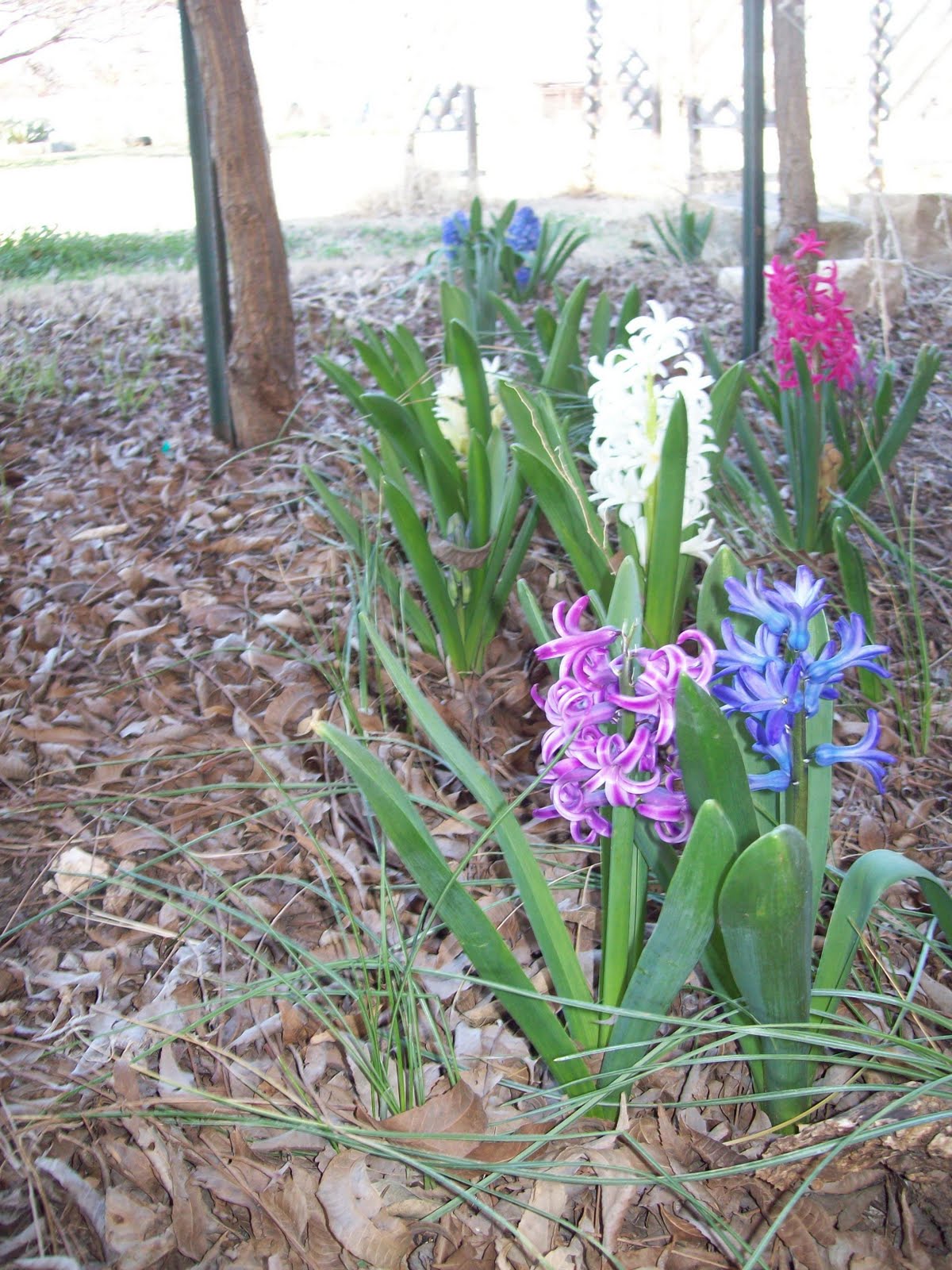
The Hyacinths are Blooming! One Blossom's Fragrance Fills a Room


Three years ago, I bought a "mixed bulb garden" assortment from one of the seed catalogs, and planted them in the fall.

The following spring, hyacinths became a part of my life. Oh my! Fragrance as rapturous as honeysuckle, and a single stalk will perfume an entire room for a week or longer.

Easy to buy: hyacinths are inexpensive, and available in most garden catalogs and at your local nurseries for fall planting.

Easy to plant: push a trowel into the ground in the autumn, drop in a hyacinth bulb and cover it over. Easy to care for: let them die back when they have finished blooming, then mow or water or fertilize whatever plants or grass cover the area the rest of the year.


Easy to enjoy: A superb cut flower, they will be beautiful and fragrant for seven to 14 days after cutting. Cheerful colors of red, white and beautiful blue are my favorites. Once a bloom stalk has opened most of its florets, cut the stalk, pop into a vase of water, and enjoy the heady perfume.

You can even force hyacinths, and stretch the season longer by chilling them in the fridge and putting the bulb in a container where the root end will sit on water - or a special "hyacinth vase". I haven't tried this yet but I think I will save a couple of bulbs this fall and try it. This website, www.kennemerend.nl/bollenglazen/ , has great photos of hyacinth vases, including antique ones. They remind me somewhat of a carafe: a sort of bottle shape, with a small neck and a top rim that widens to provide a reservoir in which the bulb sits. I've seen those odd shaped glass containers from time to time but never knew what they were for.


There's no need for any air freshener, potpourri or scented candles while you have hyacinths blooming. Because the fragrance is fully natural, the nose never ignores it, so the lovely scent catches my attention frequently each day.

I even carry the vase in & put it on the bedside table each evening, falling asleep to the fragrance of hyacinths. It joins the bird songs as one of the first things I become aware of when I wake in the morning.

Sunday, June 6, 2010

Consider the Lilies of the Field...


The Words of our Lord, Jesus of Nazareth, the Christ:

Matthew 6:27-34 (King James Version)

Which of you by taking thought can add one cubit unto his stature?

And why take ye thought for raiment? Consider the lilies of the field, how they grow; they toil not, neither do they spin:

And yet I say unto you, That even Solomon in all his glory was not arrayed like one of these.

Wherefore, if God so clothe the grass of the field, which to day is, and to morrow is cast into the oven, shall he not much more clothe you, O ye of little faith?

Therefore take no thought, saying, What shall we eat? or, What shall we drink? or, Wherewithal shall we be clothed?

(For after all these things do the Gentiles seek:) for your heavenly Father knoweth that ye have need of all these things.

But seek ye first the kingdom of God, and his righteousness; and all these things shall be added unto you.

Take therefore no thought for the morrow: for the morrow shall take thought for the things of itself. Sufficient unto the day is the evil thereof.

Saturday, March 27, 2010

Asparagus From Our Own Patch

Woohoo! 3 years ago we planted 70 asparagus crowns along the back fence. This year it is finally well established enough to pick! This was our first small batch, check out the size of two of those spears!

I tossed them in a little olive oil, sprinkled with salt and roasted them. We had them the other night with calf liver and onions.

I had never picked my own before and Paul showed me how to make sure there's no woodiness in the end. Just hold one end gently in each hand and slowly bend the spear until it breaks naturally. It finds its own break point just above the woody end.

I nearly missed the first picking, since I was away, and the freeze this week snapped the new spears, but more are coming up. We should get to pick for a few more weeks before we need to let them alone to grow and store food for next year. In our climate, spears come up and the fronds stay green all through the summer until the first freeze, packing away nutrients into their root system for the coming year.

With hardly any care, and a little luck, and the Good Lord willing, this patch of perennial vegetables should provide food for our table for many years to come. How cool is that?

Tuesday, March 23, 2010

Weather Signs & Lore: Predicting A Spring Frost

What a crazy winter it has been! And our Spring is "acumin in" by fits and starts - like Sandy said "one day 75 and the next day we have 4 inches of snow!" When will the cold weather finally end?

The signs and lore (aka natural history observations by ordinary people over time) are sometimes the only help when it comes to the "last frost" of spring. When can we safely plant tender garden veggies? In Texas, two highly reliable signs are:
(1) Never plant before Good Friday; and
(2) When the Mesquite trees leaf out, all danger of frost is past.


Easter is at its midpoint this year, on April 4th, so we don't have much longer. Especially during years of a Late Easter, it sure is hard to wait until Good Friday to plant, with our warm Texas springtime, but it pays off. One year the only snow we had in Midland was 8 inches on Good Friday.

This past year (2009), the date for Good Friday was April 10th, and we had a late frost on April 7th that was so hard it froze the leaves on our pecan trees on the North side of the house, and so widespread it decimated crops all over Central and North Texas.

In some states this maxim is adjusted: not before Derby Day or not before Memorial Day - but all seem to have a traditional touchstone date that accurately pinpoints the most extreme last killing frost date for that region.

This lore will differ from the standard horticultural guides because they use the "Average Date of Last Spring Frost", which is also useful but a different thing entirely. Here are a couple of standard guides:

Texas A&M University Spring Frosts
Dave's Garden Freeze and Frost Dates

Here is a great article from the Farmer's Almanac about how to tell when a frost is coming:
http://www.farmersalmanac.com/home_garden/a/a-gardeners-guide-to-frost

Another Easter-related bit of lore is "If it rains on Easter, it will rain for seven Sundays". In 2009, it rained on the night of Holy Saturday, and we had rain within 36 hours of Sunday for 6 out of the next 7 Sundays. So there might be some truth to this one. Let's watch and see, shall we?

Sunday, March 14, 2010

Spring, and a Thousand Generations


I was away for two weeks, and my sweet husband had flowers waiting for me on my return. Thank you Honey. So glad to be home.

Spring arrived while I was gone. Daffodils are blooming, Spring is here! No matter how cold the winter, Spring comes again.


A few days ago (on the 11th), I came upon this verse in three different places, including my own blog in the Verse of the day, in the King James version:

“Know therefore that the LORD thy God, he is God, the faithful God, which keepeth covenant and mercy with them that love him and keep his commandments to a thousand generations;” (Deuteronomy 7:9)

and on XtnYoda's blog, a blog I had never visited before, in the version from the Holman Christian Standard Bible:

"Know that Yahweh your God is God, the faithful God who keeps His gracious covenant loyalty for a thousand generations with those who love Him and keep His commands." ( Deuteronomy 7:9 )

What a beautiful promise. Christianity teaches us to honor our parents and grandparents, and to remember gratefully those who have gone before. So many of our blessings and the goodness in our lives came from them and their faith. Lord, please let my life be such that it can be another link in extending your promises through the generations to come. Thank You for the richness of Your Grace through all of time!

LinkWithin

Related Posts with Thumbnails