Wednesday, May 12, 2010

Illegal Aliens From Middle Eastern Countries Entering US at US/Mexican Border

Pat, at And So it Goes in Shreveport, has an important post about the activities of Middle Eastern Islamic terrorism groups using Mexico as an entry point to the United States.

She links to a video of Reporter Justin Farmer of Atlanta, GA, and a United States Congressional Report from 2006:

" The report also reveals the route taken by the Middle Easterners from Europe to the tri-border region in South America. Then they learn Spanish, trek to Mexico, blend in with other illegals and come on in.

" Farmer reports on several terrorists seen in the U.S., in the Atlanta area, who likely came in from the southwest border, it is believed."

The situation of illegal immigration is not what it once was, and you will have a better understanding of some issues after reading it all.

Before clicking on the link to the Congressional report ""A Line in the Sand: Confronting the Threat at the Southwest Border" in Pat's post, please be aware that it contains photos and details of brutality which are wholly unsuitable for teenagers, young mothers, anyone under stress or sensitive.

Very recent incidents of similar horror continue to be reported frequently by Mexican media and news agencies in the border areas.

This report is from 2006 - the year Congress passed the Secure Fence Act. As you watch and read, remember that Janet Napolitano has cancelled the Fence project. How she got the authority to just "cancel" an Act of Congress I do not know.

Our Government Leaders also ceased enforcing any of our immigration laws in April 2009, when an "infuriated" Napolitano "blasted Immigration and Customs Enforcement (ICE) officials and ordered a swift investigation into the [arrest of 28 illegal aliens working in a Bellingham, Washington Engine factory] because it violated Barack Obama’s promise to the influential “La Raza” movement—that undocumented workers won’t be arrested."

There are many new (as in "invented along with Too Big To Fail in the past 10 years) issues surrounding immigration today that may change your mind if you have been. like I was, still feeling more compassion than concern. As a starting point to learn more, with lots of links to reliable information, my previous posts about illegal immigration are [ here ]and [ here ].

Tuesday, May 11, 2010

Mom in High Heels: Reims France-The War Rooms

One of my favorite bloggers often posts about historical tours and field trips her family, stationed in Europe, takes. Today's post,
Mom in High Heels: Reims France-The War Rooms
is a great recap of their recent visit to the scene of Germany's official unconditional surrender on May 7, 1945 to the Allied Command. Now known in the USA as V.E. Day (Victory in Europe), this event ended the European hostilities of World War 2 (it would be 3 more months before the Empire of Japan surrendered, and longer before many in the Japanese military ceased making war).

Mrs HH has some fascinating photos, both recent and contemporary, and interesting comment on the part military protocol played in the signing event at Reims. Do check it out. For more sightseeing, you might also want to visit her homeschooling blog "Bent Grass Prep", as well.

Sunday, May 9, 2010

Ordinary Heroes : The Once and Future Greatest Generation

Being true to ourselves is part and parcel with being true to our conscience. The brave are those who act instinctively on their conscience.

Consistently, heroes say they just did what needed doing. Whatever act of bravery they performed was just part of the job, just what they think anyone else would have done, just a natural response.

Consistently, heroes say danger to themselves wasn't as great a factor as the danger to others, that either they weren't afraid, or that they HAD to act despite fear, that they had no choice but to do what they did.

Heroes are just doing what they always do, when the daily task is small and mundane, when the job is ordinary and unnoticed.

You can be a hero without ever being called to risk your life. But you cannot be a hero without ever risking hurt, embarrassment or ridicule, without following your conscience in daily living.

There are a lot of heroes in our world. Most ordinary people are heroes of the mundane. As individuals, they are shunned by the press and the powerful; as a class, ridiculed; and it makes no more difference to the ordinary hero than the dark side of the moon. They live their lives, and do the job they find at hand, and when, in the course of that life and work, courage is required, they do what needs doing.

In today's military and today's wars, care in the mundane is as essential as in civilian life. The ordinary heroes of our Armed Forces face the same shunning and ridicule by the media and the posturing elitists as the ordinary hero of the workaday world but multiplied a hundred times. It makes no more difference to the military hero than the age of the world. They do their duty, and do the job they are given, and when in the daily course of events, courage is required, they do what needs doing.

I have three sons, heroes all, each in his own way.

Nicolas has owned his own home since he was 24 - with a conventional mortgage he can afford, and growing equity. He is engaged to marry Lani in the Fall - he waited until he found his perfect match. He made sure his pets, full sized dogs, understand that "all humans are Alpha". He appreciates history and loves his family deeply. When he visits, he takes care of "honey do" tasks, and he gladly does any projects I ask him for. Nick is a good neighbor, a loyal friend, a caring son and a responsible man: an ordinary hero who is not so ordinary after all.

When Devin fell in love with Sandy, they had an early wedding to set a good example for her three children and his son. He did his part to fit the household comfortably together without drama. He remodeled our bathroom this winter. When I asked him to come install a new countertop, he decided we needed a full set of new cabinets, and he's building those now. Devin proudly adopted Sandy's daughter B., giving her the assurance of unconditional love by a father who chose her: an ordinary hero with an open heart.

Ethan came of age with September 11th, and enlisted two years later, turning 21 as a recruit. I was nervous about it but it turned out he was born for the Corps. He earned a Meritorious PFC rank during boot camp, and told me the day he graduated: "This is what I want to do. I want to come back here and be a drill instructor." After completing his MOS, he was stationed at 29 Palms, then deployed the first time to Iraq in August 2004 with the 3rd Light Armored Reconnaissance Wolfpack.

And so a Marine went to war: an ordinary hero, who did his job and looked after those beside him, for two tours of Iraq, came home, and re-enlisted when the time came.

Now, DI Sgt Ethan D. Arguello turns recruits into Marines.

He never fails to seek out older veterans for the privilege of shaking their hand.

And he never fails to remember the heroes of D Company, Third LAR Wolfpack who gave their lives but never gave up:

Sgt. Christian B. Williams, a 27-year-old from Winterhaven, Fla.

Cpl. Phillip E. Baucus, a 28-year-old from Wolf Creek, Mont.

Cpl. Adam A. Galvez, a 21-year-old from Salt Lake City.

Lance Cpl. Anthony E. Butterfield, a 19-year-old from Clovis, Calif.

Lance Cpl. Jason Hanson, a 21-year-old from Forks, Wash.

Lance Cpl. Randy L. Newman, a 21-year-old from Bend, Ore.

Lance Cpl. Shane P. Harris, a 23-year-old from Las Vegas, N.M.

Seaman Chadwick T. Kenyon
, a 20-year-old from Tucson, Ariz.

The heroism is in the willingness. It's in the doing. All those who lay their own lives on the line and pick up the torch from these who have fallen are also heroes. And they are there. Look around:

They keep enlisting and serving with gratitude, despite years of concerted media campaigns intended to disparage and demoralize our fighting forces.

They keep enlisting and serving with courage, despite trumped-up charges against their own, inexplicable leniency toward the enemy, and overblown reactions to freak occurances so rare as to be statistically invisible.

They keep enlisting and serving with pride, despite the violent apartheid of the elite barring them from "prestigious" college campuses.

They keep enlisting and serving with honor, despite politicians who abandon our allies, cast aspersions on innocent patriotic citizens, and refuse to call the enemy by name or describe his brutality honestly.

They keep enlisting and serving with compassion, despite the deaths of friends and comrades, despite seeing those they love maimed, despite knowing they may come home forever changed.

Why? Because they love us, and they love the United States of America, her Flag, her Constitution.

This is what heroes do.

Don't be deceived by the nattering of cowards, the counsel of the unwise, the taunts of bullies: The United States of America is not declining, and it shall not perish from the earth.

As The Greatest Generation goes homeward to that bright land to meet their Father and Savior, we mourn their absence from our lives - but we do not mourn for our Country.

If these men and women taught us one thing it is this: America's Greatest Generations are still ahead. Wave after wave for a thousand generations, each as courageous as the best of their ancestors and God and their own consciences can make them.

These young men and women today are our Greatest Generation.

Their sons and daughters will be our Greatest Generation.

The sons of their sons and daughters of their daughters will be our Greatest Generation.


. Marine Ethan Duncan Arguello Midland Texas

Saturday, May 8, 2010

A WWII Veteran's Perspective on Winning Hopeless Wars: Victory in Europe Day (VE DAY)

On May 8th, 1945, the armies of the Third Reich in Germany surrendered to the Allied Command, marking the beginning of the end of World War II. Japan would not surrender until August 14.

Other European, Middle Eastern, and African countries who had joined forces with the 3 main Axis Powers (Germany, Japan, Italy) had by this time either already surrendered to the Allies or had been taken over by Germany.

Audie Murphy and Edward N. Klein were two of those who made that war end on the side of the Good. I'm working on a post about Murphy, but for now, here's what Mr. Klein had to say about him, and about World War II, and about remembering our veterans:


Audie Murphy Did A Lot More Than 'Win A Bunch Of Medals'
By Edward N. Klein


"As a member of the Third Infantry Division on its campaigns from North Africa through Sicily, Salerno, Anzio, Southern France, and into Germany, I served for three years with Audie Murphy in helping to win the war.

"I never won any medals like Murphy -- nor do I consider myself a hero. I was just another soldier doing what I could to carry out my assignments and [come] back home in one piece. We all lived with death around us at all times. Home seemed a far distant and almost impossible dream. Few today realize that in 1942 the Germans had conquered most of Europe, Africa and the Mid-East with the help of their Italian Allies, and that the Japanese had taken control of the Pacific. Democracy seemed doomed.

"The thought of victory was only a dream. Hitler and Mussolini today in old newsreels look like comic characters, not the killers of millions of innocent people.

"Their armies were professionals, well trained and supplied, and ours was made up of civilians hastily gathered together with minor training and sent off to win a war.

"As we sailed across the ocean, the enormity of our mission engulfed many of us with a hopelessness that we would never be able to go home again. It was inconceivable that a bunch of amateurs could take on the best armies in the world and actually win.

"As we moved slowly and dangerously through Sicily and Italy, the courageous exploits of one of our own Third Division soldiers spread through the ranks of how Audie Murphy had helped turned the tide through his personal bravery. He gave little thought to his own life, and time after time was able to inspire others to fight in situations that appeared hopeless.

"His heroics brought him something he didn't really want: a battlefield promotion to Lieutenant, where he proved that in addition to personal heroism, he was capable of leading others in battle. Seeing him standing in a jeep as we trudged into battle, and hearing his rallying cry when we were ready to run, gave us the stamina we needed to continue.

"Young people today should relate to the fact that when Murphy won a grand total of 32 awards he was only 19 years old, with what many called a baby face. Today's youth will probably not be asked to make the sacrifices that Murphy did, but they should realize that without the young hero's willingness to make the supreme sacrifice, they might not be living in a free country today.

"Having witnessed the deaths of many young men in the prime of their lives in winning an almost hopeless war, I am sometimes dismayed today to see that their sacrifices go mostly unappreciated.

"On Veteran's Day last month there was little fanfare showing appreciation for those from World War II, Korea, Vietnam and the Persian Gulf. In fact, the newest veterans from the Persian Gulf conflict are still fighting their own government to prove their injuries and illnesses were related to the conflict. "

It is of note that Audie Murphy acknowledged that he suffered from Battle Fatigue, as Post Traumatic Stress Syndrome was then called, and lobbied Congress to provide better treatments for veterans.

There's a lot more on Audie Murphy, American Hero, at davidstuff.com's page. Please go visit, and pay your respects.

http://www.davidstuff.com/usa/murphy.htm

Tuesday, May 4, 2010

Updated: On the Gulf Oil Spill & Natural Oil Seeps

Updated 5/5/10: NASA reports that Scientists recently found they could see naturally occurring oil slicks in satellite photos: "Hu and colleagues then defined a geographic area of the western Gulf and obtained MODIS images for the month of May for nine consecutive years (2000 to 2008) from NASA's Goddard Space Flight Center, Greenbelt, Md. The team reviewed more than 200 images containing sun glint, and found more than 50 with extensive oil slicks. "

Check out this NASA satellite image of a natural oil slick in the Gulf of Mexico:


The BP Oil Spill (Pat has a good set of links ) is a tragedy in which 11 men lost their lives, and 17 were badly injured. In their families and hometowns, as well as the fraternity of the oilfields, they'll be missed a lot longer than the clean up and lawsuits will take.

It is bad news for the area until clean up efforts can get a handle on things. It will be a mess for a while, and the most significant hardship will be for those who make their living in affected waters. They will likely go through some hard times before they find alternative locations to fish, or their home waters rebound.

This is not, however, the end of the gulf as we know it. And it is certainly no reason to limit, much less stop, further oil production in the Gulf.

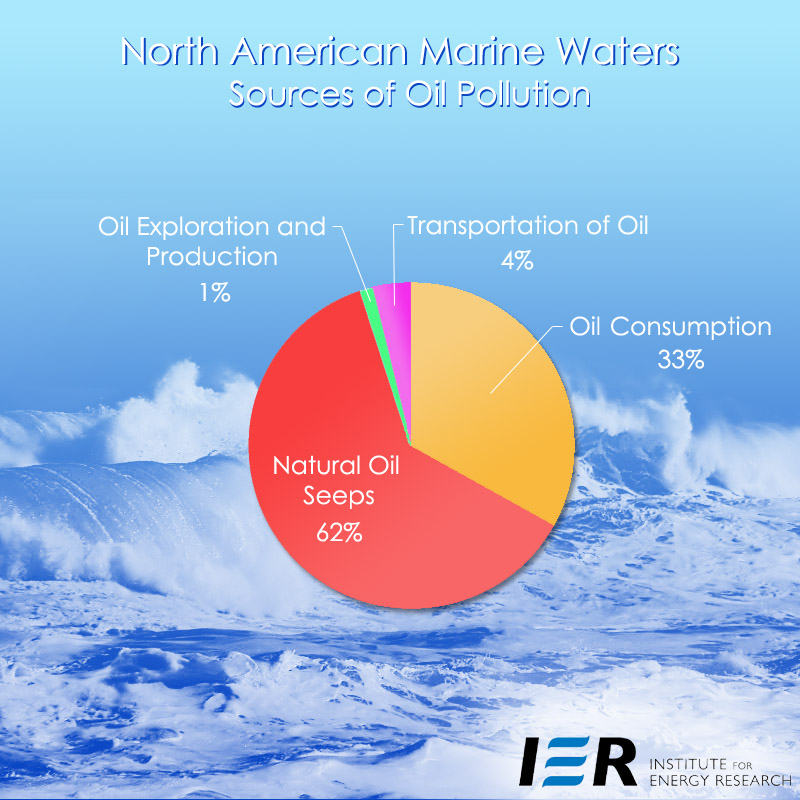
Undersea oil seeps are a naturally occurring feature of the environment, including the ocean floor. According to the Institute for Energy Research, natural oil seeps account for 62% of the oil pollution in North American waters, while Oil Exploration and Production account for only 1% (one percent).

This "natural seepage of crude oil from geologic formations below the seafloor is estimated to exceed 47,000,000 gallons in North American waters and 180,000,000 gallons globally every year. "

Anthony Watts of wattsupwiththat.com reported last year that natural petroleum seeps off the coast of Santa Barbara, California, that releases more than 20 tons of oil every single day - and has done so continuously since the Stone Age. The researchers who've quantified the volume of seepage say the amount there now is equivalent to 80 Exxon Valdez oil spills:

"A new study by researchers at Woods Hole Oceanographic Institution (WHOI) and the University of California, Santa Barbara (UCSB) is the first to quantify the amount of oil residue in seafloor sediments that result from natural petroleum seeps off Santa Barbara, California.

One of the natural questions is: What happens to all of this oil?” Valentine said. “So much oil seeps up and floats on the sea surface. It’s something we’ve long wondered. We know some of it will come ashore as tar balls, but it doesn’t stick around. And then there are the massive slicks. You can see them, sometimes extending 20 miles from the seeps. But what really is the ultimate fate?

The Minerals Management Service of the Pacific OCS Region has an excellent overview of the phenomenon:

"Even today, natural hydrocarbon seeps along the California coast continue to be more than an idle curiosity. Two small underwater containment structures positioned near Goleta Point, placed to collect natural seepage, have alone captured over 4 billion cubic feet of natural gas since 1982: enough natural gas to supply the needs of over 25,000 residential natural gas users each year.

" Native Americans of the coastal areas of California, like the inhabitants of the Old World, incorporated naturally occurring hydrocarbons into their cultures. The earliest accounts of oil and gas seepages in California come to us from the seventeenth century annals of the European explorers. Native Indians, including the Chumash, Yokuts, Achomawi, and Maidu used oil, tar, bitumen and other natural substances from the seeps for ceremonial and recreational purposes.

"In 1793, during the travels of English explorer James Cook, his navigator, George Vancouver, recorded in his journal that they had anchored off of Goleta. Vancouver reported that the sea was "... covered with a thick, slimy substance, which, when separated or disturbed by any little agitation, became very luminous, whilst the slightest breeze, that came principally from onshore, brought with it a very strong scent of burning tar." He continued that "... the sea had the appearance of dissolved tar floating on its surface, which covered the ocean in all directions within the limits of our view."

Ultimately, any oil spill needs to be avoided - but those that do occur happen because of accidents, and even the largest ones never come close to releasing the amount of oil the earth itself leaks naturally into the world's oceans.

Oil is a fluid, unlike hard minerals, it doesn't necessarily have hard borders. Mexico is drilling in its areas of the Gulf, and Cuba has signed agreements with both Russia and China , as well as other countries, for offshore drilling within its "Exclusive Economic Zone" of the continental shelf - which in some places could come closer to Florida's coast than the US rules allow our own drilling.

With these new situations, we cannot hope to "save" that oil that lies within our territories for some rainy day, nor can we wait until we think we need it to start the long hard work of drilling a successful well.

We need to go forward, with confidence. It's always time to drill.


Update #2, 05/24/10: Men who make their living on the water and the coasts in the real, natural world understand how nature works. Guys, you are awesome. I say don't wait for permission, take charge, spread the hay and send the bill to the BP, with a copy to Al Gore. (Hat tip and thanks: commenter Seven Percent Solution on May 24, 2010 at 12:11 AM on Hot Air's Quote of the Day) Also, don't miss Pat's new set of links at And So It Goes in Shreveport.

Monday, May 3, 2010

An Immigrant Speaks to the Tucson City Council


Via commenter drillanwr on Babalublog.com:

Gabriella addresses the City Council of Tucson, AZ, April 27, 2010, at a meeting to hear a motion by one of the Council members to file a lawsuit against the State of Arizona for supporting the enforcement of Federal Immigration Law through passage of SB1070.
Although the Council did not plan or take action that evening, the public was allowed to speak only after the Council had met in closed session with the lawyer they had invited to advise them about the city's options in the matter.

Gabriella says she immigrated to the United States legally in 1986, learned English, and became a citizen in 1991. She says that except for a couple of traffic violations, she has never broken the law.

Here are some excerpts from her inspiring speech:

"Because of this bill, law enforcement will have the freedom to enforce the laws of the Federal government."

"The lack of support from you, our elected officials, regarding this law is shameful. Law enforcement should be given every right to enforce the laws."

"You have been elected to oversee the city's business, not to become advocates for illegal immigration."

"I am not against immigration and neither is this bill. The United States is a sovereign country with laws and everyone should abide by them. Whether you are here visiting or plan to immigrate, there is a legal process to do so - just like I did and like the countless immigrants who came to this melting pot through Ellis Island."

"I have a question to you all. If I decide to rob a bank, all of you know that I would be breaking the law. Regardless if I lost my job and I needed the money to feed my family, I would be put in jail because I broke the law. Correct? I will be commiting a crime. So why, in anybody's mind, it is not illegal to break the immigration laws of this sovereign country?"


Thank you, Ma'am. Some of our greatest patriots, who understand how exceptional the United States of America really is, and the incalculable value of our historical rule of law and equal justice, are people who chose to become citizens. Thank you, Gabriella, for helping keep freedom alive by reminding those who stand in your place in government of their duties to uphold the law and take care of their own responsibilities.

Sunday, May 2, 2010

Macaroni and Cheese

Okie doke, for one of my daughters-in-love, here is my recipe for Macaroni and Cheese. You all enjoy! I'm cross-posting at Facebook, and putting it here so it will be easy to find in the future. That is why I originally started this blog - to make it easy to find the recipes the kids asked for.


For this batch, I used a 12 oz bag of elbow macaroni, and an 8 oz bag of grated cheddar cheese. I used to always grate my own cheese, but now it is usually the same price per pound (especially if you get the store brand) for grated as it is for block cheese. We always used cheddar or a variety (like colby, longhorn, or red-rind). You can use whatever cheese you have or like best.

Nandy loved to make his with sharp cheddar when he could get it - he called it "rat trap cheese". Boys, if you remember, he made his mac and cheese by putting one layer of cooked macaroni in a backing dish, covering it with cheese, and baking it for about half an hour. That was how we ate it when we were kids - Macaroni and Cheese was one of the meals Nandy cooked. That, and his vegetable soup, and Weenies and Saurkraut. Pretty much that was it, since either Mema or Big Grandmother did most of the cooking.

Now, where was I.. oh yeah....

Cook macaroni in salted water until done, and drain.

Put about 1/3 of the cooked macaroni in a baking dish, sprinkle lightly with salt & a grind of pepper, and dot with butter.

Dot with small spoons of either sour cream or cream cheese. I use whichever I have on hand. You could even use both, whatever you like. I started using these to make the cheddar go farther, in the days when all three boys were home and I made huge pans full of this.


Sprinkle generously with shredded cheese.

Add half the remaining macaroni to the dish, on top of that, and repeat the whole process: lightly salt, pepper, dot with butter and sour cream, sprinkle with cheese.


Top with the last of the macaroni, and do it all again. After adding the sour cream, pour a small amount, maybe 1/4 cup of milk or cream around the sides.


Finish off with a nice topping of shredded cheese.

Bake, uncovered, at 350 degrees for 15 minutes.


Serve immediately.

Say Grace, and enjoy! :-)


LinkWithin

Related Posts with Thumbnails