"I still find each day too short for all the thoughts I want to think, all the walks I want to take, all the books I want to read, and all the friends I want to see." ~John Burroughs
Showing posts with label Phenology. Show all posts
Wednesday, February 24, 2016
Sprouting Out Tomato Seeds For This Year's Garden
There are lots of seeds still in their little damp paper towels getting sprouted. Yesterday I took the varieties that have sprouted and moved them into their little seedling pots.
I saved egg shells to use for this, we will see how well that works. We have a lot of calcium in our water, but places that don't might find this technnique useful to help prevent Blossom End Rot.
There are several previous posts about how to start tomato plants from seed. Click here to go to the first one, and when you get there, you'll see links to the others. :-)
We had thunder storms night before last, and this is a part of the country where the saying applies: "Thunder in February, Frost in April"! I never plant before Easter because of late frosts, but I always start a lot of extra plants in case my first planting freezes to death!
Wednesday, May 27, 2015
Big Texas Weather: Same Old Climate, Same El Nino Events Cause Texas Floods and Texas Rains
There is nothing unusual about the rain or flooding that Texas and Oklahoma are experiencing. It is actually a feature of our same old climate, and happens especially often in El Nino years. During these past years of drought (which are also a normal feature of our same old climate), we've all been pulling for an El Nino to show up with the lovely rain it always brings.
We mourn the tragic loss of life... flash floods are the only weather I fear, and they kill more people each year than all other weather events combined. That is no comfort to the grieving families. Please learn how to be safe in heavy rain, and never cross a water-covered road.
But we must also be grateful for the abundance of rain that fills ranch tanks and the lakes that provide our water supplies. These rains are even replenishing underground aquifers, storing water for the long haul.
An enlightening statement,courtesy of Floodsafety.com, gives us the facts about these floods:
But we must also be grateful for the abundance of rain that fills ranch tanks and the lakes that provide our water supplies. These rains are even replenishing underground aquifers, storing water for the long haul.
"Flooding from large storms has affected Texas throughout its history...and destructive floods occur somewhere in the State every year. Many of these floods are destructive because they often occur in areas where extreme flooding had not occurred for many years. These floods often are perceived as unexpected or even unprecedented because their peak water-surface elevations (stages) can greatly exceed those of past floods."More facts from the same source as of 2002:
- *Texas has had 256 major floods (41 catastrophic) from 1853 thru 2002.
- *From 1986 to 2000, Texas experienced 4,722 flash flood events.
- *" Central Texas has been identified as the most flash-flood prone area in the United States by the National Weather Service."
- *"Texas holds 6 of 12 world record rainfall rates in 24 hours or less - source United States Geological Survey (USGS)."
- *"Texas leads the nation in flood-related deaths most every year -- averaging twice the next nearest state: California."
Labels:
American Indian,
Climate Change,
Common Sense,
Historical Documents,
History,
Natural History,
Phenology,
Science,
Seasons,
Self-Educated,
Spring,
Texas,
Thinking For Yourself,
traditional life,
Weather
Thursday, January 8, 2015
Planning This Years Garden & Reviewing Last Year's
In which I talk about the things I learned last year: what worked (Deer Netting!!!!) and what didn't (Oddly colored Heirloom Tomatoes!!!), and what I am looking for when I start going through the seed catalogs this year. Also, some tips on buying onion plants for Southern gardens. If you like the video, please give a "thumbs up" and subscribe on You Tube. Thank you so much :-)
Labels:
Farmers Market,
Frugal,
Garden,
Gardening,
Heirloom Seeds,
Locavore,
Phenology,
Prepping,
Seasons,
Self-Educated,
Slow Food,
Southern Food,
Texas,
Texas Food,
Tomatoes,
traditional life,
Vegetables,
Vintage Living
Wednesday, December 31, 2014
Picking and Cooking Wild Greens From Our Yard
How I gathered, prepared, and cooked Shepherd's Purse and Henbit to have as mixed greens for New Year's! Shepherd's Purse is a member of the Mustard family, and Henbit is a member of the Mint family. I was interested to learn from Wikipedia that Shepherd's Purse is a regular part of cuisines in Japan, Korea, and parts of China. Both are winter annuals that are readily available this year on New Year's Eve in Texas, as they will tolerate freezing temperatures for a while. I think they are VERY tasty!
Labels:
Budget Abundance,
Common Sense,
Cottage Food,
Frugal,
Harvest,
Knowledge,
Locavore,
Nandy,
Natural History,
Phenology,
Prepping,
Recipes,
Roadside,
Southern Food,
Texas Food,
Wild Foods,
Winter
Tuesday, November 11, 2014
Tuesday, June 24, 2014
Tomato Vines Loaded with Green Fruit: Heirloom "Costoluto Genovese"
I have only picked a couple of ripe tomatoes so far, but the vines are all full of green fruit. This variety I grew from seed that I bought from Park Seed. They are called "Costoluto Genovese", an Italian heirloom tomato that is supposed have an intense flavor that makes them good for canning and sauce. I love the lobed shapes on these!
I planted many different varieties, and in the first planting I had a nice chart of which were where. But after they all froze to death and I had to scurry to replant, I didn't track placement. So until they ripen, it is hard to tell which is which. These Genovese ones are unmistakeable though.
Monday, June 16, 2014
Mid June Garden Update: Chard, Squash, Onion Braids, and Waiting For Tomatoes!
I think the rumors that this is finally an El Nino year may prove true. God has been watering my garden every week for about a month now - including one eight inch gully washer that really DID wash a gully into our driveway - washing the gravel down onto the side of the street with the force of the runoff. I need to go shovel the gravel back into place.
It was so COLD this year! Every time we thought winter was over we would have a cold snap! I think the temperatures slowed everything down. Many things kind of just sat there, waiting. Then the past couple of weeks, things have started happening. I've been gathering Swiss Chard for about a month, baby beets with their tops on for a couple of weeks, and yellow squash all this past week. Just picked the first cucumbers today. The grasshoppers have arrived and we are having to share with them, but they are not the plague they have been the past two years. The Deer Fencing WORKS and deer have not entered my garden since I hung the mylar on it!
My onions are finished for the year. Have I mentioned that I really LOVE growing onions. You can plant them during that cabin-fever time when it seems like spring will never get here, freezes don't hurt them.
They mostly take care of themselves, and when they are ready to be picked their tops just fall over one night. They are easy to gather and store for a long time.
This year, I planted late so a lot of mine were small. I braided the large ones to hang for storage, and tied little net bags for the small ones. If I can raise enough onions next year, maybe I can demonstrate how to make the braids at the farmer's market.
So far, so good on my tomato plants. The vines all have green fruit on them but none ready to pick yet. It was about 3 weeks ago when I saw the first baby tomato, and over time each other plant has developed fruit. I have lost 3 plants to an odd ailment in which the leaves curl up lengthwise and feel hard and leathery. The plants continue to flower and even put on some fruit but they seem to dehydrate from the inside out and gradually shrink in on themselves. There are no yellow or brown spots. Everyone else I have talked to around here has mentioned this happening to their tomato plants too. From what I have read, it may have something to do with the cold nights and hot days. I have fertilized them twice since planting.
The Eggplant is starting to set fruit and there will be peppers to pick soon (peppers are another thing I really enjoy growing, but I only planted two kinds this year). Only one melon plant came up so hopefully it will bear a few cantaloupes for us. I need to plant black eyed peas and some more beets.
All my jars are washed, and I bought more Food Saver material rolls for freezing. Ready to start preserving any day now. I have already made one batch of purple plum jam, and hope to go next week to pick peaches at a Pick Your Own nearby - look over on my right sidebar for a widget to a great site for finding U-Pic farms and orchards in your area.
Now if those tomatoes will just hurry up and ripen!!! :-)
Labels:
Blessings,
Culture,
Farmers Market,
Food,
Garden,
Gardening,
God,
Harvest,
Heirloom Seeds,
Homemaking,
Locavore,
Nature,
Phenology,
Slow Food,
Southern Food,
Texas Food,
traditional life,
Vegetables,
Vintage Living
Wednesday, May 28, 2014
In The Garden After 8 Inches of Rain - and the Deer Fence is Still Working!
We have had torrential rains for the past few days. It has been wonderful - all the tanks and ponds are filling up, the trees and gardens got a good drink, and even the lakes from Brownwood to west Texas have received a good amount of runoff. It bodes well for a good summer. Thank you Father God for giving us rain in due season!
We got about 8" total at our house over the course of several days. Although my garden is on a drip irrigation, nothing will make it grow like a good rain. My dad says rain water is full of nitrogen. Seeds I planted a month ago never sprouted until the rains we had about 10 days ago, despite having been watered consistently with the drip.
I wish I had been able to plant more before this rain, but I needed to do some major weeding before anything new goes in. So... I spent about an hour this morning pulling bermuda grass in the garden. YUCK Pulling weeds with tap roots is kind of satisfying, but pulling grass is just drudgery. I may lay carpet over it this winter to kill that patch that does not want to die.
The ground was still awful squishy but I wanted to get after that dumb grass. I got the front half of 4 rows done, need a couple more hours to finish getting the grass out, then I can move to the regular weeding. Hopefully I can finish before it dries out again. Daddy gave me my grandfather's cultivator which works great between rows and has helped a lot, but there are still a lot of careless weeds and such within the rows that have to be pulled.
The tomato plants mostly look good, with many blooms but I don't see many fruiting yet. Yellow and White onions are nearly all ready to cure, and in fact most of the yellow ones are laying out drying right now. The purple onions are still bulbing.
The chard and beets are finally getting going. My chard plants have done famously, and I was able to take some to the Farmer's Market on Saturday, but the chard seed waited on the rain to sprout.
My Deer Mesh Fence has been WONDERFUL! Can you see it in the photos? This plastic mesh fencing is almost invisible, and I tied strips of mylar along the top. Before I added the mylar, deer ran through it nightly - actually, they would jump the mesh, then get scared and run through it to go out. So I put a piece of mylar every 4 or 5 feet. Since then, they have not bothered my garden at all. It crackles in the breeze and makes a noise which probably helps keep them out too. That is pretty impressive because they LOVE swiss chard!
I used Easy Gardener DeerBlock brand - made in Waco Texas - and just attached it to T-posts with zip ties. Some of the extra hangs over at the top to flap, and I let some excess puddle at the bottom because I have read that loose net barrier might keep snakes and small animals out. Seems to be working there too. So for about a hundred dollars I have a good solution. I will take the mesh down at the end of summer and save it to use again next year.
Sunday, April 20, 2014
Raising Tomatoes, Part 4: Folklore: Planting Before Good Friday & Rain on Easter
I covered each of them with glass mason jars or 5 gallon buckets, but they still all froze to death. Fortunately, I still had about 25 left of those I "raised from scratch", and was able to buy some interesting varieties to fill them out. I would have planted today, but IT IS RAINING!!!!! Isn't God good? There is another bit of lore, that if it rains on Easter, it will rain for the next seven Sundays. The last time this happened, I tracked it, and it rained within 36 hours of Sunday on 6 out of the following seven weeks.
Our friend Herb came this week and blessed us by installing a drip system in my garden. This is made with drip tape, so has an outlet built in each 16 inches. He suggested I plant tomatoes 32 inches apart, and put something tall, like corn or okra, between them. Herb did this out of simple Christian love, recognizing a need without prompting. And then he prayed over Paul while he was here. If you have wondered, this is what Christianity in action looks like. We have received so much during Paul's illness and recovery, there have been uncountable blessings from others who follow Jesus Christ. God has surely given us goodness and mercy.
Back to tomatoes. I was upset for a couple of hours after I discovered the plants I worked so long to raise had died. But I felt better after I realized I can still test a fairly broad array of varieties to see which are best for me, here in the drought-intensified Texas heat. The tomato varieties I have ended up with are:
Homestead
Better Boy
Celebrity
Rutgers
Porter
Black from Tula
Black Cherry
Pink Tye Dye
Old German
Pineapple
Mountain Spring
Black Krim
There might be a couple of others but it is hard to read my writing on the little cups after they have been wet so long. I used waxed Dixie cups to pot them in and wrote on them with black sharpie. It was very clear originally but over time has faded. Next year I guess I will use popsicle sticks.
Some of these tomatoes are bush types, and others are what they call "indeterminate" which means they grow long and tall. I will let them sprawl, since there are too many to try to cage or support. Plus, since I have the drips on them now, there is less chance of them going to sleep wet (wet leaves are bad for tomatoes - I killed all mine one year by watering them with the sprinkler. They got fungal diseases and turned up their toes.).
Wish me luck - tomorrow they go into the ground! :-)
Saturday, February 15, 2014
It's Time! Here's One Way To Start Tomato Seeds
My "determined to learn" project this year is How to Grow Tomatoes. I have not had any luck with tomatoes - poor yields (if any), plants that turn up their toes too soon, deer harvesting them before I can.... but my neighbor raises loads of lovely red fruit so reliably he even sells them commercially, so I know it can be done.
I joined a Yahoo tomato-growing group and have been reading the archives and listening to advice. One important bit of advice is to listen to growers who are in a climate zone very similar to mine, because tomatos are finicky fruit. One reason there are lots of varieties is that there are lots of variables. The experts tell me that because of our hot, dry summers, we actually have a short growing season where tomatoes are concerned. Thus, they say to look for early varieties that ripen more quickly and heat-resistant cultivars.
One very helpful person advised that I should save my own seed from those that do succeed: he says that after a few years, I will have seed specifically adapted to my location and conditions - a land race version of the type. That sounds pretty exciting. It means I need to select open pollinated types instead of hybrids, as hybrids do not generally reproduce true to form (not quite a mule, but not predictable either).
So, while I did choose a couple of hybrids, mostly I have heirlooms and varieties developed by Texas seedsmen that are proven to stand up well to our fast-rising heat. I will do another post on the varieties after they get going. I have bought from several sources (Baker Creek, Park, Burpee and Wilhite): a great source for Texas is Wilhite Seed, in Poolville. This old company has good seed for our crazy climates, including Porter tomatoes (Porter was a seedsman in Stephenville TX and his tomatoes are still legendary), their own specialty watermelons, and you cannot beat their prices - even very low shipping too.
Several people have mentioned they use a weak tea to soak or start their seeds, especially old seed. This method was described by a man named Byron. They make the tea by taking a used teabag and steeping it for a few minutes in a teacup of boiling water, which they add to cool water to make a quart. "Weak tea" is a good word for it, as you can see above. I bet no one ever saw PG Tips as "blond" as that!
I used the tea to lightly dampen the paper towels I am starting with.....
On advice of friends, as well as Tomatomania, I am using damp paper towels (you could use coffee filters) to start my seeds. Once they sprout (probably in just a few days), they can be transfered into medium by using tweezers to grasp them by the cotoledons (never the stem) and move them into the little sprouting pots. I've always had a time getting seedlings past the first two leaves in soil, partly because they can take forever to germinate. The friend who told me first about this method said it is much faster than soil-based starting.
So I lightly dampened a folded paper towel (these are those "half size" towels), laid out six individual seeds of one variety, folded the top over and placed it in a zip lock baggie labeled with the name of the variety.
I then added a bit more weak tea so that the whole towel is damp. I left the top of the baggie "ajar" without sealing it ---- not sure there, and I need to find out whether to seal them or not.
I laid all the baggies out on aluminum foil to reflect the light and heat, under a T8 florescent shop light with two daylight bulbs in it, about 4 inches above them. I think this part will need to be played with to get just right for the temps and conditiions here in my house.
There is the shop light hanging, with a shade made of heavy duty tin foil draped over it to reflect the light and keep the heat in. The shade is not needed today, but I will need to use it when the weather gets cold again - especially at night when I don't keep these rooms as warm.
Yes, I did put this little grow station right smack on the bar between the kitchen and living room. It is close to the wood stove, and that space is not required right now for anything else. Our sunny, South-facing laundry room would be the perfect place for seedlings, but I don't keep it heated so it would be too cold if it gets down in the 30s or below. I'll move the established seedlings back there as part of their hardening off process later on.
I surely hope this works! It would be so nice to not have to go buy plants! :-)
UPDATE 3/11/14: Part three is here - click to read! :-)
Saturday, January 11, 2014
January Update on My Winter Garden: Things Learned So Far
I had a lot of fun planting my first "winter garden" this year. Then, Paul got sick. But God was so good that He watered my garden for me with nice regular rains for two months! As a result, much of what I planted came up. I was able to harvest radishes and several messes of turnip greens! With turnips, plant them thickly, then when you thin them, just snip the roots off and they are lovely tender turnip greens. All those little weeds you see around the turnips in the picture are just winter annual things like chickweed and henbit - they are edible too, if you want to fiddle with them.
I just scattered all my seeds down the rows in rather wide swaths. But I learned that I can't cultivate the rows if I don't plant the seeds precisely. So come Spring, I'll use a seeder and put them down One At A Time. Then I can wheel the cultivator through the rows and take care of most weeds while they are tiny.
I also learned that most things will not live through the winter, so I better limit plantings to those things I can harvest before the arctic air comes in and it gets down to 12 degrees! Turnip greens I harvested. Turnips? Not so much. Unless they are still alive under their poor bedraggled and dehydrated dead tops - will report back on that in a couple of months!
I used scallop shells I collected when we lived on the coast for row markers. Just punched a hole in them with a nail, wrote on them with a Sharpie, and wired them to a stick. They look cute. People can't tell what they are from the street so they ask me about them LOL
Another almost-miracle was when I came home from the hospital and discovered my Saffron Crocus blooming! I planted those bulbs about 5 years ago, and they have never bloomed, not once. This year, three of them popped up their pretty little heads. Naturally, I quickly took my tweezers and collected the stamens. So now I have home-grown Saffron, nine whole threads of it! :-)
The deer always travel through my garden spot, even though we live in town. So I had planned to put up a barrier of plastic Deer Netting to keep them out. But these are not deer tracks. It is a tiny town, and most people let their dogs run around so we know most of the neighborhood pets. I thought at first there must be a new dog because there aren't any that large that come through. But then my neighbor looked at the tracks and told me it was a BOBCAT! The way to tell the difference in that cat tracks never have toenails showing, while dog (or coyote or wolf) footprints always show toenails, since they cannot retract their claws like cats do. That is one big bobcat! They are common in this vicinity, but I never dreamed of them following the deer down Main Street!
My son Nick and grandson came a day early for Thanksgiving, and set T Posts around the perimeter of the garden. My grandson is 14, and is just beginning to get his muscles. He is going to have the same powerful arms that his dad and his uncles Nick and Ethan have. He made short work of pounding the posts into the ground. It made me proud to watch them work together so comfortably.
The posts are spaced far enough apart that Daddy's tractor will still be able to fit between them. When spring comes, I'll attach the black plastic netting to them before the deer get used to finding tasty morsels inside. This is a very inexpensive solve. We can't afford to fence the whole area permanently, and these are nearly invisible from the street until we wrap them. The plastic netting can be replaced annually. And, if we want to enclose more area, these T posts are easy to remove. Well, they are if you are Nick. It was great fun watching him one-handedly pull up some that had been staking trees - posts I had not even been able to budge with all my weight behind it!
Onion plants are in at the local produce market, so I will buy them next time I am in town, and will go ahead and put them out in a portion of the garden I left for them. I LOVE growing onions. They are so rewarding, since we cook with onions every day: it feels good to raise somethng that is a real "staple" for the table. We plant the little skinny plants, not the hard bulbs, and this far South we MUST have "Short Day Onions", because we do not get the length of daylight hours they have up North. Onions are very dependent on hours of daylight to make their bulbs. If we plant the regular onions listed in most seed catalogs, they might make good green scallions, but would never make bulbs.
Our winter is moving along pretty much as the Almanac predicted: cold and wet. So other than the onions, I probably won't put anything else out until March. Then I will plant more turnips, mustard, lettuces, etc. The seed catalogues are coming in and I'm having such fun reading them and plotting what to buy. Right now is the pleasant winter day-dreaming time in the garden and I am enjoying every moment of it!
Labels:
Blessings,
Culture,
Family,
Garden,
Gardening,
Generations,
Harvest,
How To,
Natural History,
Nicolas Arguello,
Phenology,
Seasons,
Slow Food,
Texas,
traditional life,
Vegetables,
Weather,
Wild Foods,
Winter
Friday, April 20, 2012
Roses & Pecan Trees are Blooming!
These are from the only rosebush that survived the drought, but oh aren't they gorgeous! Paul commented that they "are almost florescent": a beautiful orangey coral color.
Just as glorious in their own way are the fresh, day-glo green, male pecan tree flowers. You can see the long strands of pollen-rich catkins hanging in clusters. The female flowers are too small to see, but they are just above the catkins - Pecan trees only make female blossoms if all conditions are right: enough water, enough sugars and starches....and to date no one has figured out a scientific way to consistently predict the crop. It is so unique each year that pecans are called "God's crop" by the botanists and growers who study these trees.
I am betting on a great crop from our trees this year, in part because it has been several years since we had a bountiful one, and we've had good rain (thank you, Father God, for answering our prayers and sending rain to tide Texas over despite all predictions to the contrary. The drought is not gone, but we are grateful things are much improved in most of the state).
One of our trees is a native pecan that has the sweetest nuts. I gathered 100 pounds (before shelling) from it alone our first year here. We are just finishing them up (shelled and froze them in vacuum packs), so it would be a great blessing to have a new crop to stock up again.
If you want to produce as much of your own food as possible, do consider nut trees. You can have them in cities, and even a small lot can have a pecan tree. They produce a huge amount of high-calorie, healthy food with minimal effort once they are established. Pecan trees will not grow everywhere, but here they just come up from forgotten nuts that get buried. So look around and see what grows well where you live, and add the best possible "Edible landscaping" to your yard! :-)
Labels:
Blessings,
Curb Appeal,
Firewood,
Food,
Fruit,
Garden,
God,
Harvest,
Heirloom Seeds,
Homemaking,
Natural History,
Pecans,
Phenology,
Rick Perry,
Slow Food,
Spring,
Texas,
traditional life,
Trees
Thursday, November 17, 2011
Meteor Shower Tonight & the Wee Hours of Morning! November 17 & 18 2011
If you look toward the eastern horizon this evening, from about 9:30 Central Time "straight on 'til morning", you may be able to see falling stars in the Leonid Meteor Shower. This annual event is the beautiful debris of a disintegrated comet. It's called the "Leonid" because it appears (as we see it) in and around the constellation Leo the Lion (but these shooting stars aren't anywhere near those of the constellation).
Astronomers tell us the firedrakes can be seen in all parts of the sky, so you should be able to see it from anywhere in the United States - provided the half moon doesn't glow so brightly as to hide them from view. In fact, the best chance to see them may be by facing away from the moon - and from Leo - and look to the dark part of the sky.
But if you don't get to see it, mark your calendar and save the date for next year: they are predicting a "knock your socks off" display for 2012!
Thanks to Star Date Magazine, published by University of Texas, the McDonald Observatory, for the image used here - and for consistently marvelous information about our beautiful skies.
Praise the LORD from the heavens;
praise him in the heights above.
Praise him, all his angels;
praise him, all his heavenly hosts.
Praise him, sun and moon;
praise him, all you shining stars.
Psalm 148 (New International Version)
Saturday, October 1, 2011
Healing the Burns: References For Wildfire & Drought Recovery Plantings
Every landscape contains some plants that will not grow unless they have gone through fire. These seed lay dormant, awaiting their call to action - awaiting the moment God created them for - and burst into life on burnt ground in due time.
But some locations, such as steep slopes that burned with a kiln-hot blaze, may need a little help. Especially, those prone to erosion may benefit from an extra supply of native grasses (pdf link here) mirroring those in place before the burn, so that the root systems can hold the soil in place.
One of Texas' native plant suppliers, "Native American Seed"aka SeedSource.com, has created a Wildfire Reference Guide that provides information, links to resources, tips and seed recommendations. This company has loads of information about effective use of native grasses in landscaping and in prairie restoration.
Another excellent website is "Firewise", sponsored by the National Fire Protection Association. Lots and lots of information, not only for professionals, but also excellent resources for homeowners. One full page is dedicated to tips for wildfire readiness & evacuation. Another shares plant lists provided by various State Extension Services.
The NFPA's preparedness efforts include "Ready, Set, Go!" Most of these readiness habits are important for any emergency evacuation, so it's worth reading even if you don't live in a wildfire-prone area.
We're "not out of the woods yet", but the future calls. Time to get to work on a Texas landscape that's on the mend, that will overcome the continuing drought. Although this drought that affects the entire states of Texas & Oklahoma, much of New Mexico, and even part of Louisiana, is not expected to end for another year, the Good Lord sends us rain to tide us over until the fullness of time in this natural cycle.
So now, in time for fall and winter moisture, is a good time for scattering locally-native wild seed.
We have not had major fires in our area this year. Our ecology suffers from the lack of moisture, heat and dehydration. As the rest of my St Augustine lawn dies under heavy water rationing, as have 2 mature apricot trees, a young apple tree, three young grapes, asparagus, herbs, and several perennials, I'm starting to think how to reconstruct our yard once the drought ends. And what I'm thinking is wild.
In addition to the resources mentioned above, the always-remarkable Texas Parks & Wildlife department has a great program for increasing our backyard & urban habitats called "Texas Wildscapes".
Last but not in any way least, the Lady Bird Johnson Wildflower Center has a Drought Resource Center that is especially inspiring and hope-filling right now.
The one nice thing about this summer has been not having to mow - normally a 3-hour-a-week job. What if, when I put out those new fruit trees on our extra lot, instead of being blanketed with grass that has to be cut, they were surrounded by permanent paths and un-mown, non-irrigated patches of native meadow and lovely wildflowers, like these from our visit to the Lady Bird Johnston Wildflower Center in Austin:
That could be an unexpected blessing indeed!
P.S. Tuesday, Oct 4th, is when Texas hosts National Night Out, and in our town, with no police force, our local Volunteer Fire Department is having open house - yours probably is, too. Drive over to the fire station and visit, shake hands with these uncommon young men in your community. Chances are they've spent many hours fighting or preventing fires this summer.
But some locations, such as steep slopes that burned with a kiln-hot blaze, may need a little help. Especially, those prone to erosion may benefit from an extra supply of native grasses (pdf link here) mirroring those in place before the burn, so that the root systems can hold the soil in place.
One of Texas' native plant suppliers, "Native American Seed"aka SeedSource.com, has created a Wildfire Reference Guide that provides information, links to resources, tips and seed recommendations. This company has loads of information about effective use of native grasses in landscaping and in prairie restoration.
Another excellent website is "Firewise", sponsored by the National Fire Protection Association. Lots and lots of information, not only for professionals, but also excellent resources for homeowners. One full page is dedicated to tips for wildfire readiness & evacuation. Another shares plant lists provided by various State Extension Services.
The NFPA's preparedness efforts include "Ready, Set, Go!" Most of these readiness habits are important for any emergency evacuation, so it's worth reading even if you don't live in a wildfire-prone area.
We're "not out of the woods yet", but the future calls. Time to get to work on a Texas landscape that's on the mend, that will overcome the continuing drought. Although this drought that affects the entire states of Texas & Oklahoma, much of New Mexico, and even part of Louisiana, is not expected to end for another year, the Good Lord sends us rain to tide us over until the fullness of time in this natural cycle.
So now, in time for fall and winter moisture, is a good time for scattering locally-native wild seed.
We have not had major fires in our area this year. Our ecology suffers from the lack of moisture, heat and dehydration. As the rest of my St Augustine lawn dies under heavy water rationing, as have 2 mature apricot trees, a young apple tree, three young grapes, asparagus, herbs, and several perennials, I'm starting to think how to reconstruct our yard once the drought ends. And what I'm thinking is wild.
In addition to the resources mentioned above, the always-remarkable Texas Parks & Wildlife department has a great program for increasing our backyard & urban habitats called "Texas Wildscapes".
Last but not in any way least, the Lady Bird Johnson Wildflower Center has a Drought Resource Center that is especially inspiring and hope-filling right now.
The one nice thing about this summer has been not having to mow - normally a 3-hour-a-week job. What if, when I put out those new fruit trees on our extra lot, instead of being blanketed with grass that has to be cut, they were surrounded by permanent paths and un-mown, non-irrigated patches of native meadow and lovely wildflowers, like these from our visit to the Lady Bird Johnston Wildflower Center in Austin:
That could be an unexpected blessing indeed!
P.S. Tuesday, Oct 4th, is when Texas hosts National Night Out, and in our town, with no police force, our local Volunteer Fire Department is having open house - yours probably is, too. Drive over to the fire station and visit, shake hands with these uncommon young men in your community. Chances are they've spent many hours fighting or preventing fires this summer.
Labels:
Curb Appeal,
Disasters,
Garden,
Green,
Heirloom Seeds,
How To,
Locavore,
Maintenance,
Natural History,
Nature,
Phenology,
Rebuilding,
Seasons,
Texas,
Thrifty,
Trees,
Wild Foods,
Wildfire,
Wildflowers
Sunday, March 6, 2011
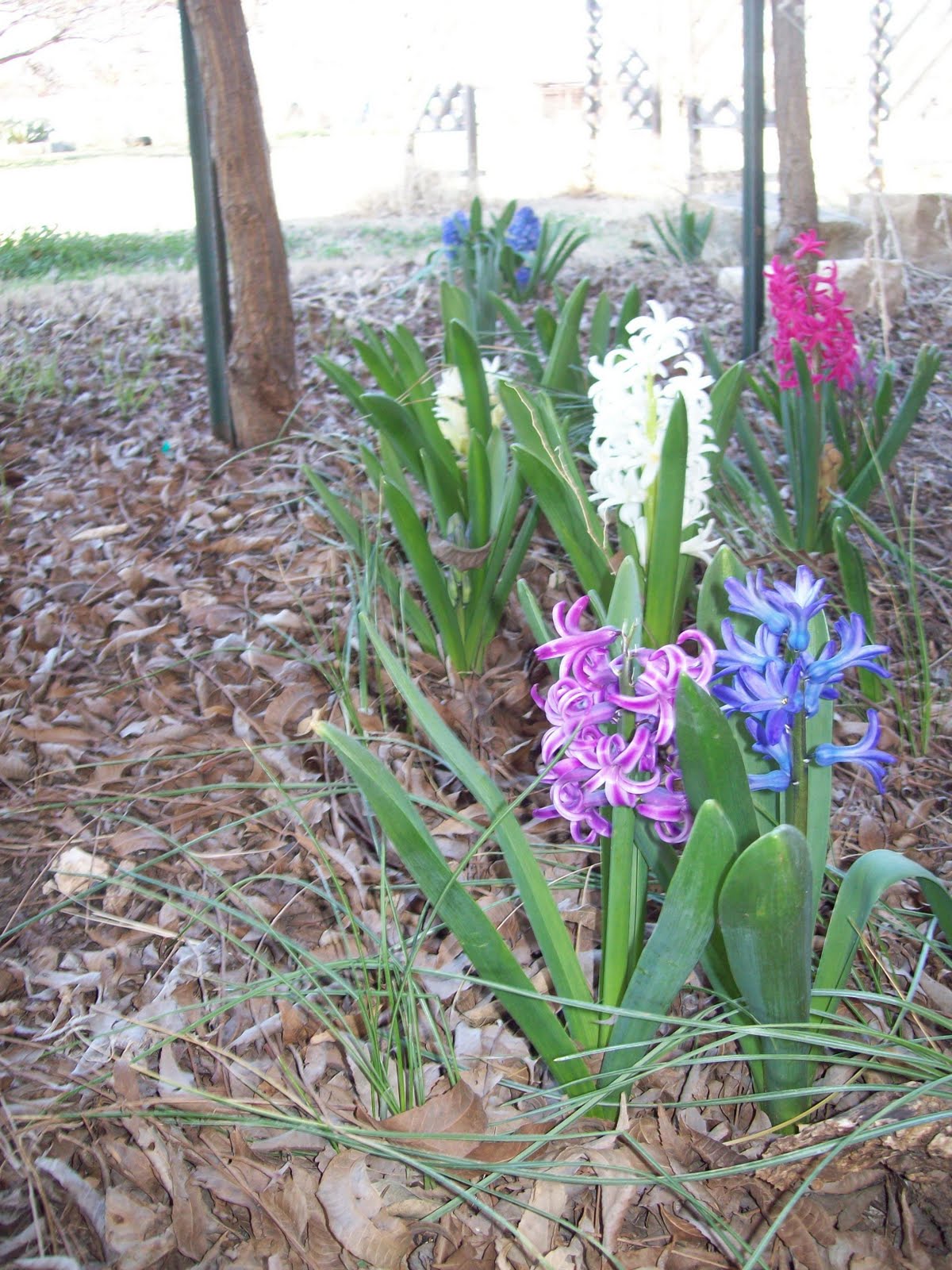
The Hyacinths are Blooming! One Blossom's Fragrance Fills a Room

Three years ago, I bought a "mixed bulb garden" assortment from one of the seed catalogs, and planted them in the fall.
The following spring, hyacinths became a part of my life. Oh my! Fragrance as rapturous as honeysuckle, and a single stalk will perfume an entire room for a week or longer.
Easy to buy: hyacinths are inexpensive, and available in most garden catalogs and at your local nurseries for fall planting.
Easy to plant: push a trowel into the ground in the autumn, drop in a hyacinth bulb and cover it over. Easy to care for: let them die back when they have finished blooming, then mow or water or fertilize whatever plants or grass cover the area the rest of the year.

Easy to enjoy: A superb cut flower, they will be beautiful and fragrant for seven to 14 days after cutting. Cheerful colors of red, white and beautiful blue are my favorites. Once a bloom stalk has opened most of its florets, cut the stalk, pop into a vase of water, and enjoy the heady perfume.
You can even force hyacinths, and stretch the season longer by chilling them in the fridge and putting the bulb in a container where the root end will sit on water - or a special "hyacinth vase". I haven't tried this yet but I think I will save a couple of bulbs this fall and try it. This website, www.kennemerend.nl/bollenglazen/ , has great photos of hyacinth vases, including antique ones. They remind me somewhat of a carafe: a sort of bottle shape, with a small neck and a top rim that widens to provide a reservoir in which the bulb sits. I've seen those odd shaped glass containers from time to time but never knew what they were for.


There's no need for any air freshener, potpourri or scented candles while you have hyacinths blooming. Because the fragrance is fully natural, the nose never ignores it, so the lovely scent catches my attention frequently each day.
I even carry the vase in & put it on the bedside table each evening, falling asleep to the fragrance of hyacinths. It joins the bird songs as one of the first things I become aware of when I wake in the morning.
Labels:
Autumn,
Decorating,
Display,
Frugal,
Garden,
Gardening,
Green,
Homemaking,
How To,
Nature,
Phenology,
Spring,
Thrifty,
traditional life,
Vintage Living
Tuesday, August 3, 2010
And How Cold Were The Winters?
Oh doesn't that snow look nice and cool right now? This is from February. We had so much snow this past winter - and so many cold days! It was one cold winter. We knew in advance that there would be snow, thanks to the Texas Winter site ( txwinter.com - linked on my sidebar)

Texas Winter is the hobby website of a Texan who enjoys meteorology and has a keen sense for prediction. It can be a real challenge to get reliable winter weather information for Texas. We have multiple climate zones and squillions of micro climates. The Farmer's Almanac does a good job generally, but it's too general to help us. So it is great to have someone who lives here really focus in.
Plus, it's intriguing to learn more about different kinds of scientific weather prediction. Because Texas Winter is the work of an individual enthusiast, it's even more fascinating to me.
Go check them out - all the posts are there from 2009/2010, and they've just announced they are going to predict the winter again this year!
~
* Title is from what are known as the "Quaker Questions", an exercise in exploring the development of faith:
Where did you live when you were a child, and who lived with you?
How cold were the winters, and how was your home heated?
Who was the warmest person in your life when you were a child?
When did you first know God as a warm Being, and how did this happen?

Texas Winter is the hobby website of a Texan who enjoys meteorology and has a keen sense for prediction. It can be a real challenge to get reliable winter weather information for Texas. We have multiple climate zones and squillions of micro climates. The Farmer's Almanac does a good job generally, but it's too general to help us. So it is great to have someone who lives here really focus in.
Plus, it's intriguing to learn more about different kinds of scientific weather prediction. Because Texas Winter is the work of an individual enthusiast, it's even more fascinating to me.
Go check them out - all the posts are there from 2009/2010, and they've just announced they are going to predict the winter again this year!
~
* Title is from what are known as the "Quaker Questions", an exercise in exploring the development of faith:
Where did you live when you were a child, and who lived with you?
How cold were the winters, and how was your home heated?
Who was the warmest person in your life when you were a child?
When did you first know God as a warm Being, and how did this happen?
Tuesday, March 23, 2010
Weather Signs & Lore: Predicting A Spring Frost
What a crazy winter it has been! And our Spring is "acumin in" by fits and starts - like Sandy said "one day 75 and the next day we have 4 inches of snow!" When will the cold weather finally end?
The signs and lore (aka natural history observations by ordinary people over time) are sometimes the only help when it comes to the "last frost" of spring. When can we safely plant tender garden veggies? In Texas, two highly reliable signs are:
(1) Never plant before Good Friday; and
(2) When the Mesquite trees leaf out, all danger of frost is past.

Easter is at its midpoint this year, on April 4th, so we don't have much longer. Especially during years of a Late Easter, it sure is hard to wait until Good Friday to plant, with our warm Texas springtime, but it pays off. One year the only snow we had in Midland was 8 inches on Good Friday.
This past year (2009), the date for Good Friday was April 10th, and we had a late frost on April 7th that was so hard it froze the leaves on our pecan trees on the North side of the house, and so widespread it decimated crops all over Central and North Texas.
In some states this maxim is adjusted: not before Derby Day or not before Memorial Day - but all seem to have a traditional touchstone date that accurately pinpoints the most extreme last killing frost date for that region.
This lore will differ from the standard horticultural guides because they use the "Average Date of Last Spring Frost", which is also useful but a different thing entirely. Here are a couple of standard guides:
Texas A&M University Spring Frosts
Dave's Garden Freeze and Frost Dates
Here is a great article from the Farmer's Almanac about how to tell when a frost is coming:
http://www.farmersalmanac.com/home_garden/a/a-gardeners-guide-to-frost
Another Easter-related bit of lore is "If it rains on Easter, it will rain for seven Sundays". In 2009, it rained on the night of Holy Saturday, and we had rain within 36 hours of Sunday for 6 out of the next 7 Sundays. So there might be some truth to this one. Let's watch and see, shall we?
The signs and lore (aka natural history observations by ordinary people over time) are sometimes the only help when it comes to the "last frost" of spring. When can we safely plant tender garden veggies? In Texas, two highly reliable signs are:
(1) Never plant before Good Friday; and
(2) When the Mesquite trees leaf out, all danger of frost is past.

Easter is at its midpoint this year, on April 4th, so we don't have much longer. Especially during years of a Late Easter, it sure is hard to wait until Good Friday to plant, with our warm Texas springtime, but it pays off. One year the only snow we had in Midland was 8 inches on Good Friday.
This past year (2009), the date for Good Friday was April 10th, and we had a late frost on April 7th that was so hard it froze the leaves on our pecan trees on the North side of the house, and so widespread it decimated crops all over Central and North Texas.
In some states this maxim is adjusted: not before Derby Day or not before Memorial Day - but all seem to have a traditional touchstone date that accurately pinpoints the most extreme last killing frost date for that region.
This lore will differ from the standard horticultural guides because they use the "Average Date of Last Spring Frost", which is also useful but a different thing entirely. Here are a couple of standard guides:
Texas A&M University Spring Frosts
Dave's Garden Freeze and Frost Dates
Here is a great article from the Farmer's Almanac about how to tell when a frost is coming:
http://www.farmersalmanac.com/home_garden/a/a-gardeners-guide-to-frost
Another Easter-related bit of lore is "If it rains on Easter, it will rain for seven Sundays". In 2009, it rained on the night of Holy Saturday, and we had rain within 36 hours of Sunday for 6 out of the next 7 Sundays. So there might be some truth to this one. Let's watch and see, shall we?
Wednesday, December 23, 2009
Cardinals: Red Birds in the Winter
Cardinals tend to flock in the winter, and this week they've been in our yard. Devin pointed out this tree full of them and I was able to get some pictures.

Cardinals mate for life. I don't know if they stay together all year, but they do come back together each Spring to raise their annual family. There were females in this flock. The little ladies don't show up in this photo, but the beautiful red birds have decorated this tree themselves.

Mema saved a baby cardinal that fell from its nest before it had feathers. This would have been back in about 1952 - now we know that it would be ok to put it back in the nest, and if unable, we'd need to take it to a licensed wild bird rehab person. But at that time, it was not illegal for her to rescue the baby bird, brush the ants off of him, and raise him to adulthood.
Junior loved Mema. He thought she was his mother, I suppose. If she talked to him he would sing for her (and cardinals have the most beautiful song - you can listen to it if you click here then click the "Listen" icon on the eNature page). Nandy made a large cage for him, and they often let him out in the house to fly around. Because he didn't eat bugs, his coloring was more subdued than the wild birds.
Junior lived to be 16 years old. He passed away peacefully and naturally while I was still in elementary school. It's unfortunate that he didn't live wild, but he still had a very good life, warm and well fed, and we all loved him.
Cardinals are delightful wild birds. They LOVE the water sprinkler on hot days and will come bathe and play in the falling spray. They like to nest in hedges, and will come back to the same yard as a nesting pair if you keep a good habitat for them.

Cardinals mate for life. I don't know if they stay together all year, but they do come back together each Spring to raise their annual family. There were females in this flock. The little ladies don't show up in this photo, but the beautiful red birds have decorated this tree themselves.

Mema saved a baby cardinal that fell from its nest before it had feathers. This would have been back in about 1952 - now we know that it would be ok to put it back in the nest, and if unable, we'd need to take it to a licensed wild bird rehab person. But at that time, it was not illegal for her to rescue the baby bird, brush the ants off of him, and raise him to adulthood.
Junior loved Mema. He thought she was his mother, I suppose. If she talked to him he would sing for her (and cardinals have the most beautiful song - you can listen to it if you click here then click the "Listen" icon on the eNature page). Nandy made a large cage for him, and they often let him out in the house to fly around. Because he didn't eat bugs, his coloring was more subdued than the wild birds.
Junior lived to be 16 years old. He passed away peacefully and naturally while I was still in elementary school. It's unfortunate that he didn't live wild, but he still had a very good life, warm and well fed, and we all loved him.Cardinals are delightful wild birds. They LOVE the water sprinkler on hot days and will come bathe and play in the falling spray. They like to nest in hedges, and will come back to the same yard as a nesting pair if you keep a good habitat for them.
Wednesday, September 23, 2009
The Kind of September
Many local wild plants are putting on berries right now. The first two photos show briars andthe third is a wild annual I haven't id'ed yet. You cannot eat either of them! Edible berries ripening now will be in a separate post (Safe Food Handling, you know). Others are blooming for their final hoorah.
The butterflies are going nuts! They will not sit still for a minute, so no pics of them. I saw a little orange one the other day chasing a larger green insect - maybe a grasshopper or a dragonfly - it looked like a sparrow chasing a hawk! The butterfly chased the larger creature into a tree, then turned around and flew back the way it came. It was a sight to see!

A couple of years ago, at Nick's, during the season when his Live Oak tree was blooming, we saw another episode of butterfly behavior. The tree was filled with bees and with butterflies. Not sure what kind of bees but I assume they were honeybees. The butterflies looked a lot like the Hackberry Emperors that come to fruit and melon rinds.
Anyway, the tree was so full of both of these that it was humming. And here's the thing: the butterflies were battling with the bees, but the bees weren't stinging. The butterflies were wrestling with the bees: jumping on them and knocking them out of the tree and wrestling
with them on the ground. The bees, on the other hand, were docile and just trying to get back up to the blossoms. It was the most unusual thing. Have you ever heard of such?

Don't forget that now is the time to plant bulbs and fruit trees! I ordered hyacinth, saffron crocus and grape hyacynth bulbs. I planted bulbs last year for the first time and OH MY! They are the best thing since sliced bread. They are easy: just dig a hole and put them in. You can even put different kinds in the same hole, at different depths.
Then in the dreary depths of winter, happy green leaves pop up, followed by flowers that last a long long time. The fragrance of the hyacinths in a vase fills the whole room. It's better than a room full of roses!
The butterflies are going nuts! They will not sit still for a minute, so no pics of them. I saw a little orange one the other day chasing a larger green insect - maybe a grasshopper or a dragonfly - it looked like a sparrow chasing a hawk! The butterfly chased the larger creature into a tree, then turned around and flew back the way it came. It was a sight to see!
A couple of years ago, at Nick's, during the season when his Live Oak tree was blooming, we saw another episode of butterfly behavior. The tree was filled with bees and with butterflies. Not sure what kind of bees but I assume they were honeybees. The butterflies looked a lot like the Hackberry Emperors that come to fruit and melon rinds.
Anyway, the tree was so full of both of these that it was humming. And here's the thing: the butterflies were battling with the bees, but the bees weren't stinging. The butterflies were wrestling with the bees: jumping on them and knocking them out of the tree and wrestling
with them on the ground. The bees, on the other hand, were docile and just trying to get back up to the blossoms. It was the most unusual thing. Have you ever heard of such?

Don't forget that now is the time to plant bulbs and fruit trees! I ordered hyacinth, saffron crocus and grape hyacynth bulbs. I planted bulbs last year for the first time and OH MY! They are the best thing since sliced bread. They are easy: just dig a hole and put them in. You can even put different kinds in the same hole, at different depths.
Then in the dreary depths of winter, happy green leaves pop up, followed by flowers that last a long long time. The fragrance of the hyacinths in a vase fills the whole room. It's better than a room full of roses!
Labels:
Autumn,
Bees,
Creatures,
Garden,
Natural History,
Nature,
Phenology,
Roadside,
Seasons,
Wildflowers
Thursday, September 10, 2009
Weather Signs & Lore: Predicting Rain and Storms
Maybe it is my age, or maybe it is because of gardening, but I have gotten interested in the weather, and specifically in "weather signs". Not signs as in superstitions, but legitimate observation of natural events.
It started when we lived on the coast. We would notice some days that there would be a strong smell in the air: we called it "stinky beach". As it turned out, that is a nearly foolproof sign of coming rain within 24 to 48 hours. It is caused by changing atmospheric pressure and affects not only bodies of water on land but also underground: drains (and your garbage disposal) will also "stink to high heaven".

We also learned on the coast just how very true the old Lore Poem is:
"Red sky at morning, sailors take warning,
Red sky at night, sailors' delight."
This is another that science has proven to be true. If the sunset is a glorious thing of beautiful red skies, you can expect the following day to be clear. If you wake to a magnificent sunrise that turns the eastern sky red, it WILL rain that day - and in fact may storm.
Nearly everyone has observed that birds fly lower in the sky, congregate in the trees and huddle down prior to a rain.
We've all also noticed "flies sticking". This was in fact the most common bit of weather lore I heard during my childhood. When houseflies get sluggish and come sit on the screens, people would say "The flies are sticking - it is going to rain". And sure enough, a thunderstorm would come up. You'll notice the humidity is high and heat oppressive during these times as well.
An Easter-related bit of lore that I heard this year for the first time is "If it rains on Easter, it will rain for seven Sundays". This year it rained on the night of Holy Saturday, and we had rain
within 36 hours of Sunday for 6 out of the next 7 Sundays. So there might be some truth to this one.
We had thunder last night, and got 1/8" of rain. It is cloudy this morning and we have a chance to have more. The crickets and frogs are singing, the cicadas are humming, and the birds are sitting in the trees singing this morning at 9:43 AM. The squirrels are staying put, but there's just enough of their clicketty chatter to know they are there. It's a beautiful noise.
Our friends at Lake Brownwood really need rain for their water supplies, so we are hoping it will pour buckets!
Tina
091109 9:53 am Edited to add: It started raining at 9:22 last night and rained throughout the night. We have gotten a little over 1" so far and it is still misting rain today.
It started when we lived on the coast. We would notice some days that there would be a strong smell in the air: we called it "stinky beach". As it turned out, that is a nearly foolproof sign of coming rain within 24 to 48 hours. It is caused by changing atmospheric pressure and affects not only bodies of water on land but also underground: drains (and your garbage disposal) will also "stink to high heaven".

We also learned on the coast just how very true the old Lore Poem is:
"Red sky at morning, sailors take warning,
Red sky at night, sailors' delight."
This is another that science has proven to be true. If the sunset is a glorious thing of beautiful red skies, you can expect the following day to be clear. If you wake to a magnificent sunrise that turns the eastern sky red, it WILL rain that day - and in fact may storm.
Nearly everyone has observed that birds fly lower in the sky, congregate in the trees and huddle down prior to a rain.
We've all also noticed "flies sticking". This was in fact the most common bit of weather lore I heard during my childhood. When houseflies get sluggish and come sit on the screens, people would say "The flies are sticking - it is going to rain". And sure enough, a thunderstorm would come up. You'll notice the humidity is high and heat oppressive during these times as well.
An Easter-related bit of lore that I heard this year for the first time is "If it rains on Easter, it will rain for seven Sundays". This year it rained on the night of Holy Saturday, and we had rain
within 36 hours of Sunday for 6 out of the next 7 Sundays. So there might be some truth to this one.
We had thunder last night, and got 1/8" of rain. It is cloudy this morning and we have a chance to have more. The crickets and frogs are singing, the cicadas are humming, and the birds are sitting in the trees singing this morning at 9:43 AM. The squirrels are staying put, but there's just enough of their clicketty chatter to know they are there. It's a beautiful noise.
Our friends at Lake Brownwood really need rain for their water supplies, so we are hoping it will pour buckets!
Tina
091109 9:53 am Edited to add: It started raining at 9:22 last night and rained throughout the night. We have gotten a little over 1" so far and it is still misting rain today.
Labels:
Creatures,
Garden,
How To,
Nature,
Phenology,
Seasons,
Sunday,
Texas,
traditional life,
Vintage Living,
Weather
Subscribe to:
Posts (Atom)